

The Ultimate Guide to Finding a Rope Basket That Holds Shape: 2026 Buying Guide
A storage basket should be a permanent anchor in your home, not a collapsed heap of fabric on the floor. Most mass-produced bins are engineered for the convenience of flat-shipping rather than the reality of daily life. You've likely experienced the disappointment of unboxing a piece that arrives creased and never quite recovers, leaving your space looking cluttered instead of curated. Finding a genuine rope basket that holds shape requires moving beyond the flimsy cotton alternatives found in big-box aisles. It demands a focus on high-tension weaving and the kind of structural integrity usually reserved for the open sea.
We understand that your home is a sanctuary where every object should serve a purpose and tell a story of quality. You don't want to replace your organizers every year; you want pieces that endure. In this 2026 guide, you'll discover the specific materials and manual artistry required to create baskets that remain upright and beautiful for a lifetime. We'll explore the shift toward sustainable, natural fibers and provide the technical insights you need to invest in storage that survives the rigors of a busy household while maintaining its coastal charm.
Key Takeaways
- Distinguish between the inherent weakness of soft-spun cotton and the structural permanence of marine-grade lobster rope.
- Learn how to identify a premium rope basket that holds shape by evaluating weave tension and fiber density.
- Discover why hand-weaving offers superior structural control and durability compared to standard machine-stitched alternatives.
- Master the selection process by matching basket size and material reinforcement to your specific storage requirements.
- Explore the engineering behind handcrafted storage solutions designed to remain upright and functional for years.
The "Floppy Basket" Problem: Why Most Rope Baskets Lose Their Shape
Structural integrity is the ability of a basket to maintain its silhouette under load. It is the silent soul of a functional home. Most rope baskets on the market today are engineered for the convenience of the logistics chain, not the longevity of your curated sanctuary. They arrive vacuum-sealed and folded flat, a process that permanently compromises the fibers before the product even reaches your door. Once those creases are set into a soft-spun material, the basket rarely regains its intended form. You are left with a storage solution that looks messy because it simply won't stand upright. Finding a rope basket that holds shape requires looking past these disposable, mass-produced options.
Gravity is a relentless force. Over time, loose machine-stitching fails as the fibers stretch under the weight of blankets, logs, or toys. If the construction lacks a high-tension core, the walls will inevitably bow outward. This is the common "floppy basket" syndrome; it's a cycle of purchase and disappointment that clutters the home rather than organizing it. A basket should be an anchor, not a collapsed heap of fabric on the floor.
The Material Science of Soft vs. Rigid Fibers
Cotton is a fiber designed for comfort, not architecture. While it feels pleasant to the touch, it lacks the inherent rigidity needed to defy gravity. Many products use a decorative "rope-look" cotton that mimics the aesthetic of traditional basket weaving techniques without providing the necessary strength. In environments with high moisture or humidity, these soft fibers absorb water and sag even further. They lose their grip. They lose their soul. A true storage vessel requires a material that treats structure as a primary requirement, moving beyond the limitations of soft-spun textiles.
Why Steaming and Stuffing is Only a Temporary Fix
Online tutorials often suggest steaming or stuffing a new bin to restore its shape. This is a cosmetic band-aid for a structural wound. If a basket lacks an internal core of high-performance materials, no amount of external heat will provide lasting stability. True structural memory comes from the tension created during the weaving process, not from a temporary application of steam. Without internal tension, the basket will return to its collapsed state the moment it's emptied. You need an investment-grade solution built with a structural core that remembers its shape through years of daily use.
The Anatomy of a Sturdy Storage Basket: Materials That Defy Gravity
Softness is often marketed as a virtue in home decor. In the world of organization, however, softness is the enemy of order. To find a rope basket that holds shape, you must look toward materials engineered for resilience rather than just tactile comfort. Marine-grade lobster rope stands as the gold standard for structural rigidity. Unlike the limp cotton cordage found in mass-market bins, lobster rope is designed to endure the crushing pressures and abrasive salt of the North Atlantic. It possesses an inherent stiffness that allows a basket to maintain its silhouette even when empty, serving as a permanent architectural element in your home.
The secret to this permanence lies in synthetic reinforcement. High-quality baskets utilize blends of polypropylene and polyester, materials that offer a superior weight-to-rigidity ratio. A heavier rope creates a more stable, grounded base that resists tipping. These fibers are also treated for UV resistance, which is critical for longevity. Without this protection, the "spine" of a basket can become brittle and snap after a few seasons of sunlight. By choosing reinforced materials, you ensure your storage remains a legacy piece rather than a disposable item. If you have questions about which material weight is right for your environment, you can contact our artisan team for personalized advice.
Marine-Grade Rope vs. Residential Cordage
Residential cordage, like jute or cotton, is prone to stretching and absorbing moisture. This leads to mold, mildew, and a gradual loss of form. Marine-grade rope is engineered for the elements. It is hydrophobic and naturally resistant to the rot that plagues organic fibers. When subjected to the "stand-up" test, a marine-grade basket maintains a proud, vertical stance without any internal support. This reliability is rooted in traditional weaving methods that prioritize the relationship between material strength and functional geometry.
Structural Memory and Longevity
Structural memory is the tendency of a material to return to its original woven shape after being stressed. Soft fibers have poor memory; once they slump, they stay slumped. Reinforced lobster rope possesses a spirited energy that resists "slumping" over time. This all-weather durability means your home organization remains crisp and intentional, regardless of how often the basket is filled or moved. It is the difference between a container that merely holds items and one that anchors a room with its steady, reliable presence.
Evaluating Construction: Tight-Weave vs. Machine-Stitched Baskets
Construction is the architecture of the home. It is where raw material meets human intent. While many mass-market options rely on a "hand-woven look," they often hide a fundamental flaw: the machine-sewn zigzag stitch. This method creates weak points between coils, allowing the walls to buckle under the slightest pressure. A genuine rope basket that holds shape is built through high-tension weaving that binds the rope into a singular, rigid unit. This process demands a level of precision that machines simply cannot replicate. It is about the deliberate application of force to ensure every layer supports the one above it.
The base serves as the anchor of the entire silhouette. If the foundation is loose or poorly reinforced, the walls will inevitably bow. A sturdy, reinforced bottom ensures that the weight of the contents is distributed evenly, preventing the dreaded "slumping" effect seen in cheaper alternatives. Handle integration is another critical detail. Handles should be woven directly into the body of the basket rather than simply tacked on as an afterthought. This structural continuity ensures the basket doesn't deform or stretch when lifted, maintaining its elegant profile even under a heavy load of firewood or winter blankets.
The Proprietary Tight-Weave Advantage
High-tension weaving creates a self-supporting skeleton within the vessel. It is a slow, methodical process. By increasing the density of the weave, the artisan ensures vertical stability that resists the pull of gravity. This approach is similar to our Proprietary Tight-Weave: Structural Integrity in Mats, which utilizes high-tension techniques to prevent deformation through years of foot traffic. In a basket, this density translates to a piece that stands proud and remains upright, even when it sits empty in the corner of a room.
Spotting Quality in the Details
Quality is found in the absence of gaps. You can spot a failing basket by looking for loose coils or visible spaces between the rope layers. Perform the "squeeze test" before you buy. Press the sides of the basket firmly with your hands; there should be a clear, springy resistance rather than a soft collapse. An artisan-made piece feels substantial and grounded. It avoids the tired, collapsed look of goods designed for the convenience of a shipping container. Understanding these methods requires a respect for long-standing Textile Traditions that prioritize the delicate balance between tension and form.
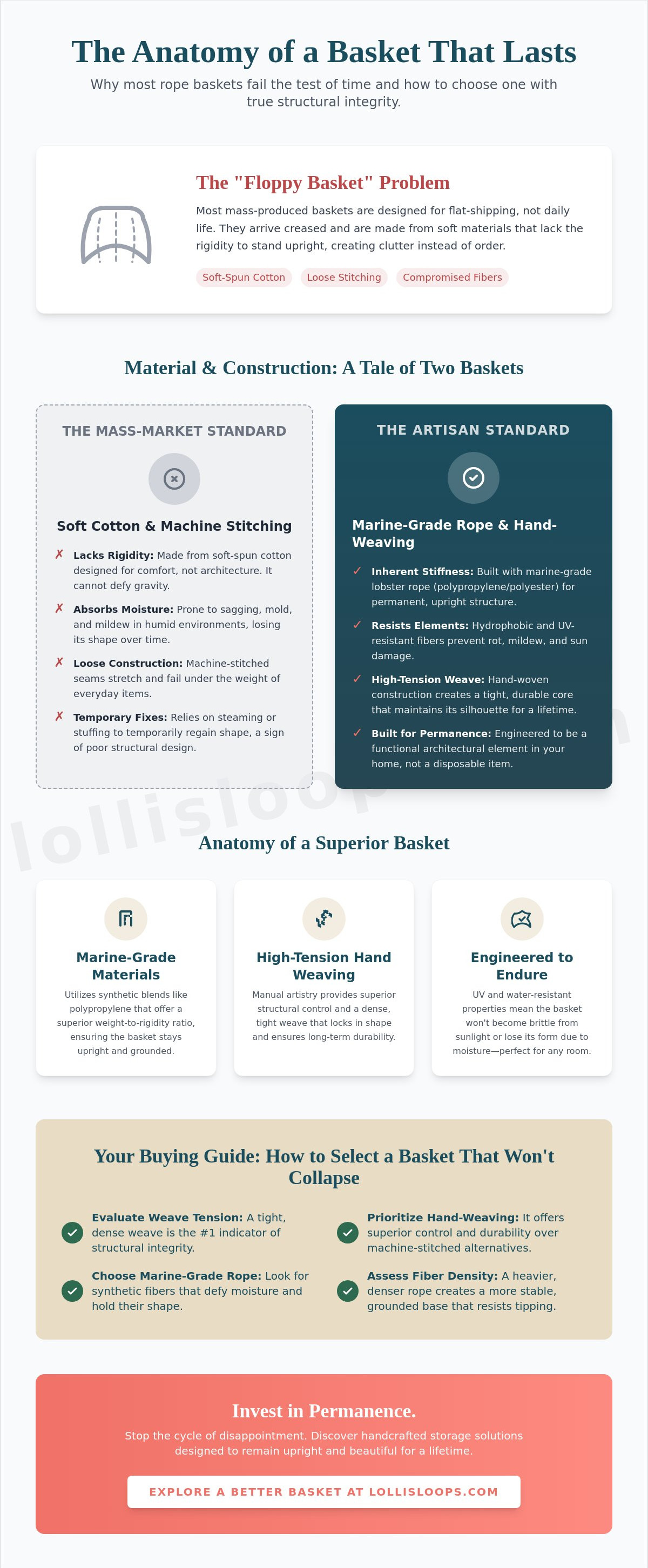
Buying Guide: How to Select a Rope Basket That Won’t Collapse
Selecting the right storage piece is an exercise in intentionality. It is the moment where you decide how your home will function and how its stories will be told. To select a rope basket that holds shape, you must first define the weight it will carry. A vessel designed for soft linens requires a different structural tension than one meant to hold heavy oak logs for the hearth. Matching the basket to its burden is the first step in ensuring a lifetime of use without the disappointment of sagging walls or a buckled base. It's about finding the balance between the load and the loom.
Size introduces its own set of engineering challenges. As a basket grows in diameter, the pull of gravity increases exponentially. A large-scale piece must possess significantly higher weave tension to remain upright. Without this added rigidity, a large basket will eventually slump under its own weight, regardless of how lightly it is filled. We prioritize high-performance materials for this reason. They provide the necessary spine to support expansive silhouettes without sacrificing the refined coastal aesthetic your home deserves. It is a marriage of rugged durability and sophisticated design.
Matching Basket Size to Storage Needs
A rope basket for blankets needs specific wall height and tension to keep bulky textiles contained and organized. These larger pieces act as visual anchors in a living room, providing a sense of order and warmth. Conversely, selecting smaller baskets for entryway organization or mudroom tidiness allows you to curate small essentials without overwhelming the space. For more inspiration on integrating these pieces into your decor, read our guide on How to Choose and Style a Coastal Storage Basket.
The Environmental Factor: Indoor vs. Outdoor Use
The sanctuary of your home extends to the porch and the mudroom. These high-traffic, high-humidity areas demand materials that resist the elements. All-weather rope is essential here. It stands up to salt, sand, and sun without becoming brittle or losing its shape. Marine-grade materials are naturally hydrophobic. They don't absorb the moisture that leads to rot in cotton alternatives. Maintenance is simple. You can power wash a high-quality rope basket to remove seasonal debris, and it will retain its structural integrity once dry. If you're unsure which size or material is best for your specific entryway, ask our artisan team for a recommendation.
The Lolli’s Loops Standard: Handcrafted Baskets Built for Permanence
At Lolli’s Loops, we operate as bold traditionalists. Our artisan workshop is a place where time-honored methods meet modern resilience; it is a space dedicated to the slow, deliberate pace of manual craft. We don't believe in the culture of disposability. Instead, we craft every hand-woven rope basket to be a permanent fixture in your sanctuary. By utilizing reinforced marine-grade lobster rope, we ensure that you finally own a rope basket that holds shape through years of daily use. We refuse to compromise on structural integrity. This means our products never arrive vacuum-sealed or folded. They reach your door in their true, proud form, ready to serve as a reliable anchor in your home.
Our commitment to quality is rooted in the physical process of creation. We understand that a storage vessel is only as strong as its tightest loop. While mass-produced alternatives prioritize shipping efficiency, we prioritize the architectural silhouette of the finished piece. Each basket is a testament to the artisan difference, featuring a proprietary tight-weave that provides maximum integrity. This meticulous attention to detail ensures that the walls remain vertical and the base remains grounded. It is a level of stability that transforms a simple household object into a piece of functional art.
From the Sea to Your Sanctuary
The story of our materials begins in the North Atlantic. Our rope is engineered to withstand the harshest ocean conditions, from abrasive salt spray to the crushing weight of the tides. This maritime heritage makes our baskets naturally resistant to mold, mildew, and fading by design. It is the same high-performance fiber found in our Shop our Signature best-sellers, which are trusted to endure the elements year after year. Whether your basket sits in a sun-drenched living room or a high-traffic mudroom, it will remain steadfast and vibrant, echoing the rugged beauty of the coast.
Artistry in Every Loop
The process of hand-weaving is a soulful narrative. It requires a technical expert who understands the unique tension of every fiber. Each loop is tightened with intention, creating a self-supporting skeleton that defies the slumping common in residential cordage. A Lolli’s Loops basket is more than a container; it is an investment in your home’s legacy. It represents a choice to value longevity over convenience. To bring this level of craftsmanship and structural permanence into your own space, Explore the Hand-Woven Basket Collection and discover a rope basket that holds shape for a lifetime.
Investing in Structural Permanence for Your Home
The choice of a storage vessel is ultimately a decision between the temporary and the timeless. You now understand that a genuine rope basket that holds shape is born from the intersection of high-tension marine engineering and meticulous manual artistry. By prioritizing reinforced marine-grade lobster rope over soft-spun cotton, you ensure your home remains a curated sanctuary free from the clutter of collapsed bins. Our proprietary tight-weave construction provides the maximum structural integrity required to defy gravity and the rigors of daily life. These handcrafted pieces are not just functional; they're mold, mildew, and fade-resistant, making them reliable anchors for both indoor and outdoor environments.
We invite you to move beyond the cycle of flimsy alternatives and embrace the steady, quiet confidence of investment-grade craftsmanship. Your home deserves objects that tell a story of quality and endurance. Discover the Hand-Woven Baskets That Stand the Test of Time. May your space always reflect the intentional beauty of a well-ordered life.
Frequently Asked Questions
How do you make a rope basket stand up again if it has collapsed?
You can restore a collapsed basket by stuffing it tightly with blankets or luxury pillows from Canvello for 24 to 48 hours. Using a handheld steamer on the creases helps relax the fibers so they can be reshaped into their intended silhouette. If the basket lacks a structural core, this fix is often temporary. For a permanent solution, you need a vessel engineered with high-tension materials that resist slumping from the start.
What is the best material for a rope basket that holds its shape?
Marine-grade lobster rope is the superior choice for a rope basket that holds shape. This material is engineered for the rigors of the North Atlantic, offering an inherent rigidity that soft-spun cotton cannot match. Synthetic blends like polypropylene provide a structural spine that remains upright even when empty. These fibers are also hydrophobic, preventing the moisture absorption that causes natural materials to sag over time.
Are cotton rope baskets durable enough for heavy storage?
Cotton rope is generally too soft for heavy storage applications like firewood or large toy collections. While pleasant to the touch, cotton lacks the tensile strength to support significant weight without bowing. For heavy loads, look for reinforced synthetic fibers. These materials provide the necessary architecture to maintain a proud silhouette, ensuring your storage remains functional and elegant under pressure.
Can I wash a rope basket without it losing its structural integrity?
You can wash high-quality marine rope baskets with a garden hose or power washer without compromising their form. Because these materials are hydrophobic, they don't absorb water deep into the core, allowing them to dry quickly while maintaining their original tension. Avoid machine washing, as the agitation can break down the weave. Simply spray, scrub with mild soap, and let it air dry in the sun.
Why do some rope baskets arrive folded and how do I fix the creases?
Many mass-market baskets are folded flat to reduce shipping costs and warehouse space. You can attempt to remove these creases with a heavy steam treatment and internal stuffing. It's a sign of a "floppy" design. Premium baskets are shipped in their full form to protect their structural memory. If a rope basket that holds shape is your goal, avoid products that can be easily folded for shipping.
What is the difference between machine-stitched and hand-woven rope baskets?
Machine-stitched baskets typically use a zigzag sewing pattern to join coils, which creates weak points that eventually stretch and fail. Hand-weaving allows an artisan to control the tension of every loop, building a self-supporting skeleton. This manual process ensures a level of structural density that machines cannot replicate. It's the difference between a decorative container and a piece of permanent home architecture.
While machine-based construction has its structural limits in heavy basketry, the technology is unmatched for intricate textile decoration; you can learn more about Embroidery n Sewing to find high-quality digital embroidery patterns for your own machine projects.
How long should a high-quality rope basket last?
A high-quality basket made from marine-grade materials should last for a decade or more. These pieces are designed to be legacy items in your sanctuary. Because they are resistant to UV rays, mold, and mildew, they don't degrade like natural jute or cotton. With minimal care, a well-crafted basket will maintain its upright stance and vibrant color through years of daily use.
Does the thickness of the rope affect how well a basket holds its shape?
Rope thickness plays a vital role in the stability of a basket. A thicker, heavier rope provides a more grounded base and stronger walls, which is essential for larger silhouettes. However, the material composition is just as important. A thick cotton rope will still slump more than a thinner, high-tension marine rope. The ideal combination is a substantial diameter paired with a rigid synthetic core.

Article by
Mary Mooney (Lolli)