The Definitive Guide to the Tight Weave Doormat
A doormat shouldn’t leave a trail of fibers or fade into a tired first impression. A tight weave doormat starts with construction: how closely the material is woven, how well the mat holds its shape, and how its surface fits the entrance. At the threshold, those details influence both everyday use and the overall impression of your home.
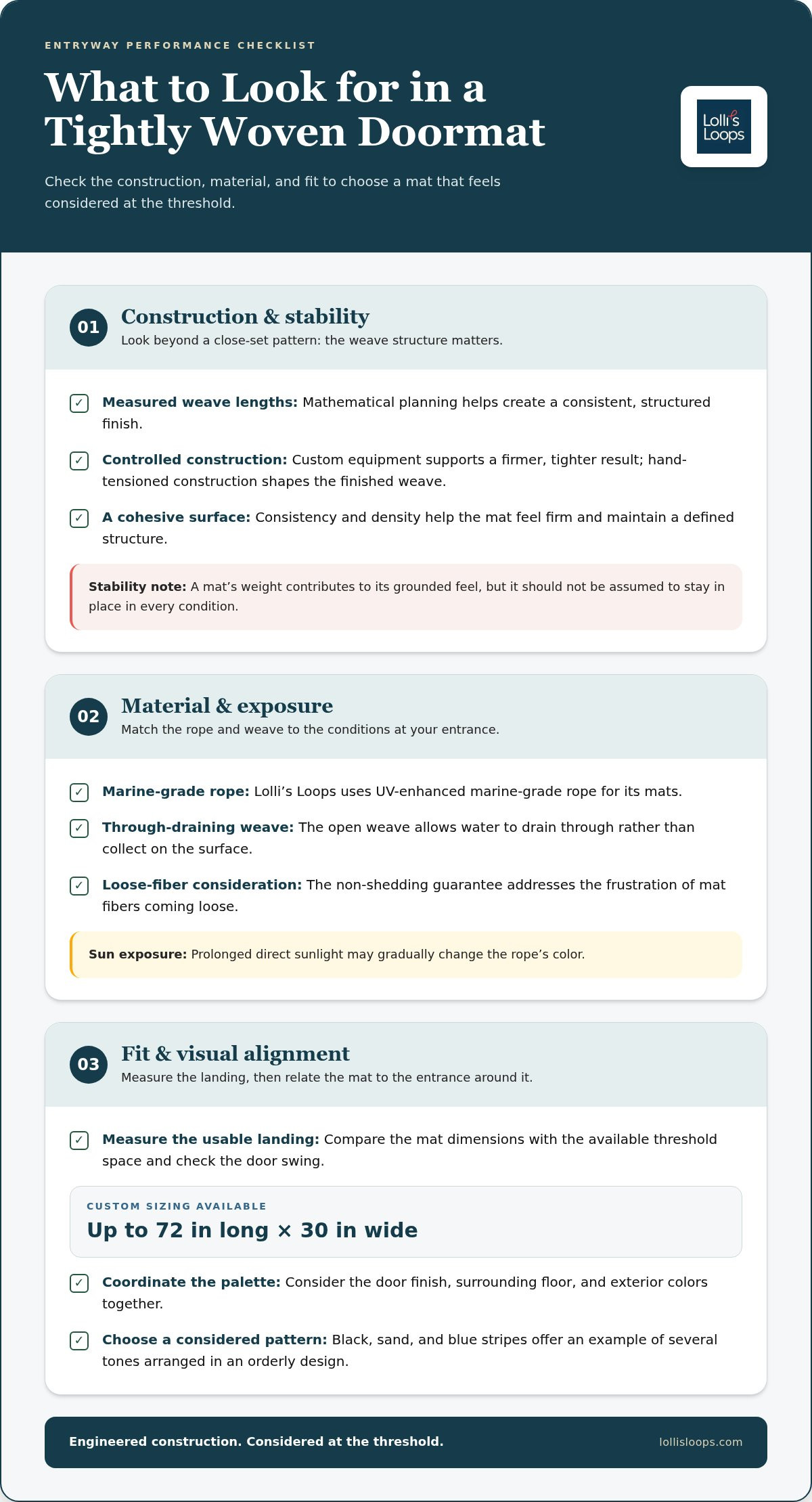
Lolli’s Loops brings mathematical weave planning and UV-enhanced marine-grade rope together in handwoven mats designed for a firm, composed finish. Each mat is handwoven to order, one loop at a time. Its non-shedding guarantee addresses one common frustration with loose-fiber mats, while the open weave allows water to drain through. Prolonged direct sun exposure may gradually change the rope’s color.
This guide explains what to look for in a tight weave, how construction affects stability, and how to choose a size and design for your entrance. You’ll also find practical guidance on measuring, care, and matching stripes or wave-inspired patterns to your home’s exterior.
Key Takeaways
- A tight weave doormat combines a firm surface with a considered design, making it part of the entryway rather than an afterthought.
- Mathematical weave planning and hand-tensioned construction help create a consistent, structured finish.
- UV-enhanced marine-grade rope and a through-draining weave are practical features for an exposed entrance. Prolonged direct sun exposure may gradually change the rope’s color.
- Choose a color and pattern in relation to your door, exterior finishes, and available landing space.
- Compare the mat’s dimensions with the clear space at the threshold, and follow the care instructions: shake out loose debris or rinse with a garden hose; allow to air-dry fully.
The Architectural Significance of a Tight Weave Doormat
An entry mat is among the first surfaces encountered at home, yet it is often chosen as a finishing accessory rather than as part of the entrance itself. A tight weave doormat can give the threshold a clearer visual boundary and a more substantial feel. That matters when the door, flooring, and porch palette have been selected with care.
Think of the mat as an architectural anchor. It grounds the doorway, adds texture alongside stone or other hard surfaces, and links the exterior styling to the entrance. A mat that sheds fibers or loses its shape can make the threshold feel less considered. Lolli’s Loops makes handwoven rope doormats to order, one loop at a time, combining a purposeful design with engineered construction. For a general overview of how doormats function at the threshold, see Doormat.
Why Loose Weaves Compromise Your Entrance
Loose fibers can come free under regular foot traffic, adding the mat’s own material to the dust and grit carried inside on shoes. Coir is a familiar doormat material, but its fibers can shed, and the material can retain moisture. In an exposed, damp setting, these characteristics may mean more cleanup and a mat that becomes less tidy over time.
Construction also affects how a mat sits. If the weave is loose or soft, the surface may feel less uniform and can lose its defined shape with use. A firmer, tightly formed weave is designed to maintain a more consistent structure. Lolli’s Loops uses mathematically determined weave lengths to shape a firmer construction, and its mats come with a non-shedding guarantee. The result is a considered alternative to loose-fiber mats without adding an unlisted backing material.
Defining the Premium Entryway Investment
A premium entryway mat earns its place through its materials, construction, and visual presence. Handwoven detail gives the surface texture, while a deliberate design can bring coherence to a threshold. Rather than treating a mat as a temporary accent, consider how it will relate to substantial doors, stone steps, and other exterior details.
Texture can soften the hard lines of a doorway, while color can echo architectural details or create a measured contrast. For example, the black, sand, and blue striped rope doormat brings several tones to the threshold while keeping the pattern orderly. It is handwoven to order, one loop at a time, from UV-enhanced marine-grade rope. Prolonged direct sun exposure may gradually change the rope’s color.
Consider the mat alongside the door finish, the surrounding floor, and the exterior palette. When these elements relate to one another, the entrance reads as a designed whole rather than a collection of separate choices. That is the value of an architectural anchor: a functional surface that also contributes to curb appeal.
The Engineering of Stability: Mathematical Weave Optimization
A rope mat’s performance depends on more than its material. Rope lengths, weave sequence, and structural consistency all influence how firmly the finished surface holds together. At Lolli’s Loops, mathematical planning determines optimal weave lengths. This measured approach supports both the mat’s appearance and its structure, while hand-tensioned construction gives the weave its finished form.
Small variations in a weave can affect how uniform the surface feels and how clearly its pattern reads. A carefully planned arrangement helps maintain consistency across the mat. The goal is a firm, cohesive surface, not simply a pattern that looks close-set from a distance.
Proprietary Manufacturing Techniques
Custom equipment gives the maker control over forming the weave and helps create a firmer, tighter result. Rather than shaping the rope without a plan, the process uses calculated lengths and a deliberate pattern. Each mat is handcrafted, so engineering guides the construction while skilled hands shape the finish.
Rope responds to tension. If a weave is too slack, it may feel less firm; a carefully managed structure helps the finished mat retain its intended form. This is why a tight weave doormat is more than a visual preference. The consistency and density of the weave are central to how the mat feels and functions at the threshold.
Structural Benefits of Density
A firmly constructed mat has a substantial feel underfoot and a cohesive surface. Its weight contributes to that grounded presence, although no mat should be assumed to stay in place in every condition. Consider the exposure of the entrance and choose dimensions that suit the landing, rather than relying on weight alone to determine stability.
A consistent surface also offers a defined place for shoes to meet the threshold. Lolli’s Loops’ non-shedding guarantee addresses the separate issue of loose mat fibers migrating indoors. Together, these are useful distinctions to consider when comparing a tightly woven rope mat with a loose-fiber alternative.
For an entrance with unusual dimensions, custom doormat information can help you plan a fit that suits the threshold. Custom sizing is available up to 72 in long × 30 in wide. Measure the usable landing and check the door swing before choosing dimensions.
Marine-Grade Performance: UV Resistance and All-Weather Drainage
An outdoor mat encounters changing conditions, from bright sunlight to damp air and grit on shoes. Material and weave are therefore practical considerations as well as design choices. Lolli’s Loops uses UV-enhanced marine-grade rope, and its open weave allows water to drain through rather than collect on the surface.
Sunlight can gradually alter the appearance of outdoor colors. UV enhancement is an important material feature, but it is not a promise that a mat’s color will never change. If the entrance receives direct sun for extended periods, take that exposure into account when choosing a shade and coordinating it with your exterior palette.
Engineered for Coastal Extremes
In an exposed entryway, water management matters alongside appearance. The weave allows water to pass through, rather than leaving it pooled on top of the mat. Choose a place where water can drain away, and avoid positioning the mat in a low spot where runoff collects. Placement gives the mat room to drain after wet conditions.
The rope is designed for demanding outdoor environments, but good placement and care still matter. A mat trapped where water collects may take longer to dry. Leave it where air can circulate, and allow it to air-dry fully after rinsing or exposure to wet conditions.
Drainage can help prevent water from lingering on the mat’s surface, but it should not be treated as a guarantee against mold or mildew. Regular care and allowing the mat to dry fully are sensible steps for an outdoor entrance.
Maintenance and Longevity
Care is straightforward: shake out loose debris or rinse with a garden hose; allow to air-dry fully. The open weave lets water drain through during rinsing. Follow these care instructions rather than using unlisted cleaning methods. For additional details, explore the rope doormat cleaning guide.
Regularly removing loose debris can help keep the threshold presentable. The non-shedding guarantee also means the mat is designed not to add loose fibers to the foyer. Its rope construction, through-draining weave, and defined care instructions make it a practical option for entrances that see everyday use.
For a particular entrance, Lolli’s Loops’ contact information provides a way to discuss a custom-size mat. Measure the available space and note any details that may affect placement, such as the door swing or a nearby step.
Elevating Curb Appeal with Curated Gradient Designs
A well-composed entryway depends on how color, texture, and proportion work together. A rope mat can connect the door to the porch palette, echo a detail in the exterior, or introduce a considered contrast. Thoughtful color curation makes the mat part of the overall design rather than an isolated accent.
Begin with the elements that are already in place: the door finish, hardware, surrounding stone or siding, and nearby planters or greenery. A restrained palette can sit naturally alongside pale stone or subdued trim. Stronger tones can create a focal point beside a quieter exterior. The aim is not to match every surface, but to choose colors that feel intentional together.
Gradient transitions and wave-inspired patterns add movement without overwhelming the entrance. A gradual shift between colors can soften strong architectural lines, while a wave motif brings a more fluid note. These designs draw the eye toward the door and give the threshold character.
Color Theory for Modern Entryways
Consider the full approach to the door, not just the door color. A mat that echoes a hardware finish or picks up a subtle landscape tone can create continuity. A contrasting accent can bring definition to a quieter façade. Choose a color combination with the surroundings in mind, and remember that prolonged direct sun exposure may gradually change the color of the UV-enhanced marine-grade rope.
Pattern and Texture as Design Elements
Stripes create a sense of order, while wave patterns introduce softer movement. A Signature Stripe design pairs a structured pattern with a considered color arrangement; a wave-inspired design can complement organic landscaping or curved architectural details. The Captains Rope Doormat in Blue and Sand offers one example of a composed two-color palette.
Proportion matters as much as pattern. A mat that looks undersized beneath a broad entry door can make the threshold feel unbalanced; one that overwhelms a narrow landing can crowd the approach. Compare the door’s width with the usable porch space, and consider nearby steps or sidelights. Custom sizing is available up to 72 in long × 30 in wide, so measure the landing and check the door swing before deciding on dimensions.
Before choosing a design, look at the doorway as a complete composition. Note its dominant tones, choose a detail to echo, and decide whether the mat should blend in or provide contrast. If you’re planning a tailored fit, discuss a custom-size doormat with Lolli’s Loops. A considered choice of color, texture, and scale can give the entrance a more cohesive first impression.
The Bespoke Experience: Securing Your Home Investment
A bespoke entryway piece is made with its destination in mind. Consider how its dimensions, construction, and design will serve the entrance, rather than choosing on appearance alone. Lolli’s Loops mats are handwoven to order, one loop at a time, from UV-enhanced marine-grade rope. Mathematically planned weave lengths and hand-tensioned construction shape a firmer, tighter finish. Made-to-order items typically ship 5–7 days after order.
Made-to-order production means each mat is created for the order rather than selected from stocked inventory. When planning a porch or entryway, account for the typical shipping timeframe alongside your other design decisions. For custom sizing, consider the actual dimensions of the landing and the clearance required for the door to open freely.
The Craftsmanship Journey
From planned rope lengths to the completed weave, each handcrafted mat brings material and method together. Bespoke production allows the mat to be made in the selected dimensions, including custom sizing up to 72 in long × 30 in wide. Mathematical planning supports a firmer structure, while hand-weaving gives the finished piece its distinctive texture.
The mat’s construction begins with its material and planned weave. A carefully formed surface is designed to maintain its shape through regular use. The combination of performance and finish makes a tight weave doormat a purposeful choice for a home where daily function and architectural character matter equally.
Making Your Selection
Start with the character of the entrance. A stripe can bring order and rhythm; a wave pattern introduces softer movement. Choose colors that relate to the door, hardware, exterior finishes, or landscape, then decide whether the mat should blend in or provide a measured contrast. Lolli’s Loops offers handwoven rope doormat designs, including signature stripes and a coastal wave pattern. Each mat is handwoven to order, one loop at a time, from UV-enhanced marine-grade rope.
For fit, measure the clear width of the landing where the mat will sit, then measure the usable depth from the door to the edge of the step or walkway. Check the door swing and leave enough clearance so the mat does not interfere with opening or closing. For an unusual threshold, custom sizing is available up to 72 in long × 30 in wide.
Compare the mat’s dimensions with the available space before ordering. Standard sizes are Small, 19 × 32 in; Regular, 22 × 36 in; Large, 22 × 40 in; and Statement, 24 × 50 in. Mats are approximately 1–1½ in thick, with minor variation between individually woven mats, and weigh approximately 8–10 lb, depending on size. If you plan to use one indoors on a smooth surface, use a rug pad for added grip.
Make the Threshold Your Next Design Decision
A considered entrance begins with a choice about how you want arriving home to feel. Let the doorway guide your decision, then select a tight weave doormat that suits the setting and the welcome you want to extend.
Before choosing, compare the mat’s dimensions with the usable landing, consider how the door opens, and decide which colors and patterns belong with your exterior. For care, shake out loose debris or rinse with a garden hose; allow to air-dry fully. Keep in mind that
When you’re ready to plan a tailored fit, discuss a bespoke doormat for your entryway with Lolli’s Loops.
Frequently Asked Questions
Do tight weave rope doormats shed like coir mats?
Lolli’s Loops offers a non-shedding guarantee for its mats. Coir fibers can shed, which may be noticeable where a porch meets pale interior flooring. The guarantee concerns shedding; it does not mean the mat cannot collect ordinary dirt from shoes. Shake out loose debris or rinse with a garden hose, then allow the mat to air-dry fully.
How long does a marine-grade lobster rope doormat last?
No fixed lifespan is stated. Each mat comes with a three-year warranty for craftsmanship and structural integrity. The warranty defines the period of coverage; it is not a prediction that every mat will last exactly three years or a promise of service beyond that period.
Can I use a tight weave doormat on an uncovered patio?
Yes. These mats are designed for uncovered patios as well as doorways. On a smooth indoor floor, use a rug pad for added grip. For an outdoor landing, consider whether the mat can sit flat without obstructing a walkway or door. Measure the available space and check the door swing before choosing a size.
How long does shipping take for these doormats?
Made-to-order items typically ship 5–7 days after order. Factor that timeframe into your entryway plans, especially if you are coordinating the mat with other design decisions.
Are these doormats heavy enough to stay put in high winds?
They weigh approximately 8–10 lb, depending on size. That gives the mat a substantial feel, but it is not a guarantee that it will stay in place during every wind event. Consider how exposed the entrance is and whether the mat’s dimensions suit the available landing. Do not assume weight alone makes any outdoor mat immovable in severe conditions.
How do I clean a tight weave rope doormat?
Shake out loose debris or rinse with a garden hose; allow to air-dry fully. Shake the mat to remove loose debris, or rinse it when needed. Let it dry fully before placing it back in a covered or indoor area.
Do you offer custom sizes for architectural double doors?
Yes. For double doors, measure the usable landing and note any sidelights, steps, or nearby walls that affect placement. Check the door swing so the mat will not catch against the bottom of the doors. These measurements help you choose dimensions suited to the actual threshold.
Is the rope UV-resistant to prevent fading in the sun?
The mats use UV-enhanced marine-grade rope, and If preserving a particular shade is important to your exterior palette, consider how much direct sunlight reaches the entrance. UV enhancement is a material feature, not a promise that the rope’s appearance will never change.