

The Best Salt Resistant Doormat for 2026: A Guide to Coastal and Winter Durability
Your doormat isn't failing because it's cheap; it's failing because it was never designed to survive the harsh chemistry of the elements. Most homeowners accept the inevitable cycle of shedding coir, frozen fibers, and stubborn white stains as a seasonal tax. You've likely watched your welcoming entryway transform into a soggy, faded mess after just a few months of winter de-icing or coastal spray. It's a frustrating reality. Finding a high-performance salt resistant doormat is the only way to break this cycle and protect your home's threshold.
Investing in marine-grade durability is about more than utility; it's about honoring the entrance to your curated sanctuary. We'll show you why traditional mats trap moisture and allow salt to anchor deep within their fibers, leading to rapid decay. You'll discover how lobster rope, once used to withstand the brutal Atlantic, provides the drainage and UV resistance needed to last for years rather than months. We're going to explore how a specialized weave and hand-woven craftsmanship can turn a functional necessity into a permanent piece of your home's legacy.
Key Takeaways
- Learn how salt crystals physically shred organic fibers from within and why traditional materials like coir aren't built for harsh environments.
- Discover why marine-grade lobster rope serves as the ultimate salt resistant doormat material by refusing to absorb corrosive brine or moisture.
- Understand how open-weave geometry allows salt and sand to pass through the mat, preventing the slushy buildup that causes freezing.
- Identify the best color palettes and patterns to mask salt residue while maintaining a high-end aesthetic for your home sanctuary.
- See how handcrafted techniques and technical expertise from skilled artisans create a threshold that stands the test of time.
The Invisible Corrosive: Why Salt is the Silent Killer of Entryway Mats
Salt is a master of disguise. It arrives as a fine coastal mist or a heavy gray slush, but its chemical intent is always the same. To the untrained eye, a salt stain is merely an aesthetic nuisance. In reality, it is a structural assault. True salt resistance is not about simply repelling water. It is the ability of a material to remain entirely chemically inert when exposed to sodium chloride. Without this inertness, your entryway decor is on a countdown to failure from the moment it is placed on the threshold.
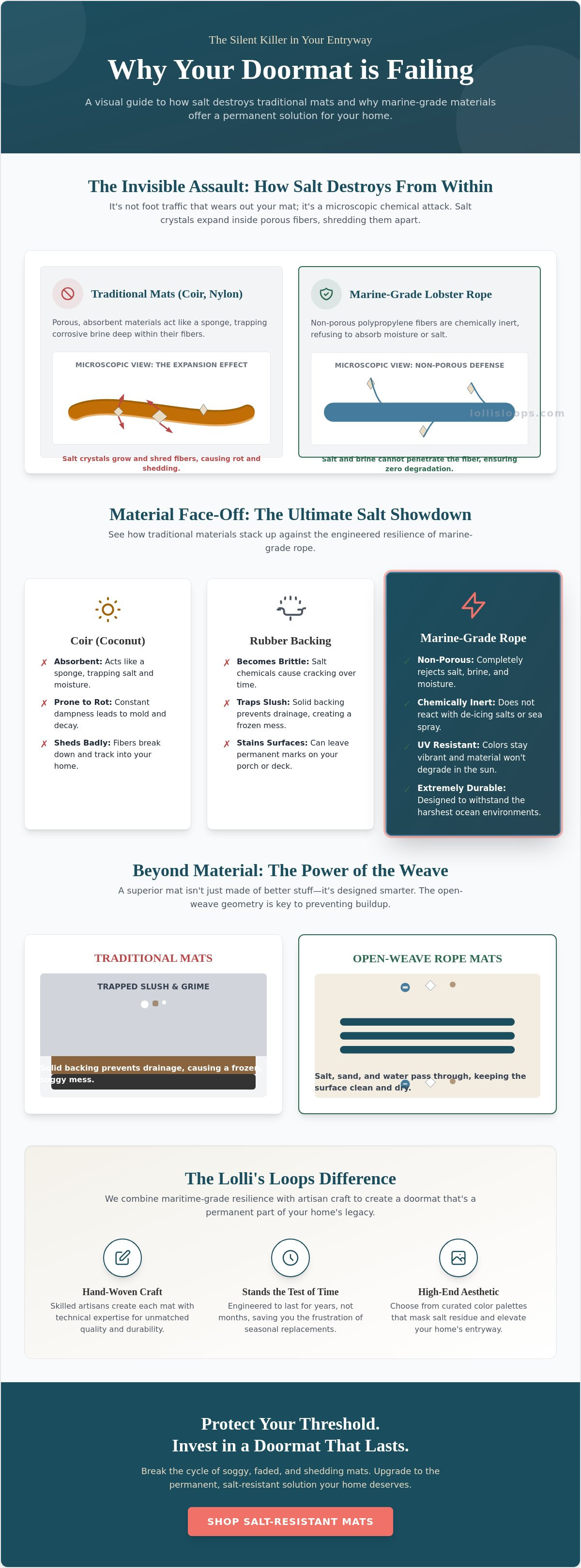
Most homeowners assume their mats wear out from heavy foot traffic. They don't. They succumb to the expansion effect. When brine seeps into porous fibers and evaporates, it leaves behind microscopic salt crystals. These crystals grow with every wetting and drying cycle. As they expand, they act like jagged wedges, physically shredding the internal structure of the material from within. This process mirrors how salt accelerates corrosion in metals; it creates a cycle of degradation that most entryway decor simply cannot survive. Selecting a high-quality salt resistant doormat requires moving beyond natural fibers that act as sponges for this corrosive brine.
Coastal Salt vs. Winter Road Salt: Different Enemies, Same Result
Coastal homeowners face a relentless, year-round battle. Airborne salinity creates a constant, invisible film on every surface, slowly dulling colors and weakening fibers. In contrast, winter climates deal with the seasonal violence of calcium chloride and rock salt. These de-icing agents create a highly alkaline slush that eats through natural materials with startling speed. The result is always the same. White, crusty stains and bleached patches appear, signaling the end of a mat's functional life and ruining the aesthetic of a curated home sanctuary.
The Failure of Traditional Materials
Standard entryway solutions are often the first casualties of a salty environment. They lack the specialized engineering required to remain stable under chemical stress.
- Coir (Coconut Fiber): These mats are naturally absorbent. They trap salt deep in the husk, turning into a salt sponge that eventually rots, sheds, and loses its shape.
- Rubber Backing: Salt causes rubber to become brittle. It eventually cracks and loses its grip; this often leads to permanent staining on the very porch or patio it was meant to protect.
- Nylon: These synthetic fibers often hold onto salt particles between the weaves. This leads to permanent stiffness and a significant loss of color vibrancy over time.
A true salt resistant doormat must be non-porous to avoid this internal destruction. By choosing materials designed for the elements, you ensure your home's first impression remains as enduring as the architecture itself.
The Science of Salt Resistance: Marine-Grade Rope vs. Traditional Fibers
A common misconception in entryway decor is that "waterproof" equals "salt-resistant." It does not. While many mats can handle a summer rainstorm, they quickly surrender to the corrosive effects of road salt and heavy sea spray. Water eventually evaporates; salt stays behind to finish the job. A high-performance salt resistant doormat must be engineered from materials that are chemically inert, meaning the sodium chloride molecules simply cannot find a foothold to begin their destructive work.
Marine-grade rope, specifically the type used in lobster fishing, is the gold standard for this environment. This isn't a happy accident of design. This rope was engineered for the abyss. It is crafted from high-density polypropylene, a non-porous polymer that refuses to absorb moisture or brine. Because the fibers are smooth and sealed, salt crystals cannot anchor themselves inside the material. Instead of becoming a "salt sponge" like traditional options, these mats remain structurally sound even after years of exposure to the harshest Atlantic winters or Pacific mist.
Why Marine-Grade Polypropylene Wins
The secret lies in the material's chemical indifference. Salt is aggressive, but it requires a porous surface to do its damage. Polypropylene provides no such luxury. Brine passes through the open weave rather than soaking into the core of the fiber, which effectively prevents the internal crystal growth that shreds inferior mats. Additionally, this material offers exceptional thermal stability. It won't become brittle and snap in freezing slush, nor will it soften and lose its shape under the intense heat of a coastal summer. When paired with UV-stabilization, the rope resists the "one-two punch" of sun and salt that typically bleaches the life out of entryway decor.
Material Comparison: At a Glance
| Material Type | Salt Absorption | Shedding | Expected Lifespan |
|---|---|---|---|
| Coir (Coconut Fiber) | High (Traps brine) | Constant | 6-12 Months |
| Standard Rubber | Medium (Cracks over time) | None | 1-2 Years |
| Marine-Grade Rope | Zero (Inert) | None | 5+ Years |
Beyond the material itself, the method of construction matters. Many commercial mats rely on fibers glued to a backing. Salt is notoriously effective at eating through adhesives, leading to "balding" patches. Our marine-grade rope outlasts traditional coir because it relies on a proprietary tight-weave system. There is no glue to fail and no backing to crack. If you are looking for a threshold that maintains its elegance through every season, consider the timeless durability of a Signature Stripe Doormat, where artisan craftsmanship meets maritime resilience.
Beyond the Surface: How Drainage and Weave Geometry Combat Salt
The design of a high-performance salt resistant doormat relies on a counterintuitive principle: it shouldn't hold anything. Traditional mats are often marketed on their ability to trap debris. While this sounds effective, it creates a dangerous reservoir in salt-heavy climates. When a mat holds onto sand and grit, it simultaneously captures the brine that fuels the corrosion reactions that degrade our infrastructure and your home's entryway. Effective protection requires a shift from trapping to filtering. If a mat cannot breathe, it cannot survive the elements.
Geometry is the silent protector of your threshold. An open-weave construction allows salt crystals and abrasive sand to fall through the mat rather than sitting on the surface. This creates a "scrub and release" mechanism. The rugged texture of the rope effectively cleans boots, but the physical gaps in the weave ensure that the captured debris is immediately deposited onto the ground below. This prevents the formation of stagnant brine pools that can lead to permanent staining and fiber rot. Airflow is equally vital. Rapid evaporation ensures the mat stays dry, preventing the soggy, frozen state that plagues inferior products.
The Trap vs. Flow Philosophy
Solid-back mats are a liability for high-end porches. They trap moisture and salt against the flooring, which can lead to the slow destruction of stone, brick, or wood surfaces. Our Wave Pattern and Signature Stripe designs are engineered with a specific airflow geometry. They act as a filter, allowing wind and air to circulate through the fibers. By allowing the elements to move through the mat, you protect the sanctuary behind the door. This flow-through design is why our mats remain clean and vibrant while others become encrusted with white residue.
Structural Integrity: The Proprietary Tight-Weave
Longevity is born from tension and weight. A salt resistant doormat must be heavy enough to withstand coastal winds without shifting, a common issue known as mat migration. Our proprietary tight-weave system is achieved through manual craftsmanship, ensuring the rope remains anchored even under heavy foot traffic. This structural stability is essential for maintaining the mat's shape over years of exposure. Explore the benefits of our no-mold doormat construction to see how intentional drainage preserves both the mat and your home's foundation. This isn't just a mat; it's a technical solution for a demanding environment where standard entryway decor fails.
Selecting Your Shield: A Climate-First Approach to Salt-Resistant Mats
Choosing the right protection for your home is a tactical decision. It requires an honest assessment of your specific environment. Coastal residents face a relentless, fine-mist salinity that settles on every surface daily. Those in snowy regions deal with the heavy, alkaline slush of calcium chloride during the winter months. A high-quality salt resistant doormat serves as the primary defense for your interior flooring. When selecting your shield, prioritize size. A larger mat provides more surface area for "salt stripping," ensuring that boots are thoroughly cleaned before they ever touch your hardwood or stone.
The goal is to blend rugged durability with the refined atmosphere of a curated home sanctuary. Your entryway is a storyteller; it speaks of heritage and quality. By choosing a mat that anchors the space, you create a transition from the wild elements to the quiet comfort of your living space. This is where technical expertise meets soulful design. A well-chosen mat doesn't just work; it belongs.
Color Theory for Salt-Heavy Entryways
Visual camouflage is a practical necessity in harsh climates. Lighter tones like silver or sand are naturally gifted at masking the white, crusty residue left behind by evaporating brine. Our Signature Stripe patterns are particularly effective. The rhythmic variation of colors breaks up the visual field, hiding debris far better than a solid, dark surface. Because we use UV-stabilized dyes, these colors remain vibrant even under the twin assault of high-noon sun and salt spray. You don't have to sacrifice your aesthetic palette for performance.
Maintenance: The Rhythmic Care of a Rope Mat
The beauty of a marine-grade mat lies in its simple maintenance cycle. For daily care, a quick shake and a spray with a garden hose is all that's required. This is the "Shake and Spray" method. Unlike coir, which would rot under such treatment, our rope thrives when rinsed. For deeper seasonal cleaning, you can even use a power washer. The high-pressure stream lifts stubborn winter salt buildup without fraying the fibers. A mild detergent can be used for a deep refresh, ensuring your threshold remains as welcoming as the day it was woven. If you're ready to upgrade your entryway with a piece that survives the seasons, explore our Solid Color Doormat collection for a timeless, resilient finish.
The Lolli's Loops Difference: Artisan Craft Meets Maritime Resilience
In the quiet coastal town of Southport, North Carolina, we believe that a threshold deserves more than a temporary solution. We've taken the rugged utility of the Atlantic and refined it into a welcoming anchor for your home. Every salt resistant doormat we create is a testament to manual artistry. It is an intersection where technical expertise meets a soulful narrative of heritage. By sourcing 100% Marine-Grade, UV Enhanced Lobster Rope, we ensure that your entryway remains a curated sanctuary, untouched by the corrosive reach of the seasons.
Investing in quality is a quiet act of rebellion against the culture of the disposable. While a standard coir mat might last a single winter before shedding and rotting, our handcrafted rope mats are built for a legacy of permanence. This is the "Bold Traditionalist" approach. We respect the time-honored methods of maritime weaving while introducing the innovation required for modern longevity. Each piece is designed to be the last mat you'll ever need to buy for your threshold.
Artisan Quality You Can Feel
The tactile experience of lobster rope is unique. It is rugged enough to strip heavy road salt from boots yet sophisticated enough to complement a high-end architectural aesthetic. Every mat is hand-woven with a focus on structural integrity. We utilize a proprietary tighter weave system that prevents the mat from losing its shape or loosening under heavy foot traffic. This meticulous attention to detail ensures a consistent, premium feel. For those with unique architectural requirements, we offer a Custom Size Doormat, ensuring your salt-resistant solution is tailored precisely to your sanctuary's dimensions.
A Sustainable Choice for the Modern Home
Sustainability is often found in stability. By choosing a mat designed to last years rather than months, you significantly reduce the cycle of landfill waste generated by discarded, rotted entryway decor. We stand behind this commitment to craftsmanship with a three-year warranty on structural integrity and manual production. This is the difference between a simple purchase and a meaningful investment in your home's foundation. It is an anchor that provides warmth, hospitality, and a steady sense of place. Shop our Signature Stripe collection and find your forever doormat today, and welcome the elements with confidence.
Secure Your Threshold for the Seasons Ahead
Salt shouldn't dictate the lifespan of your home's first impression. By moving beyond the absorbent trap of traditional fibers and embracing the chemical inertness of high-density polymers, you choose a path of permanence. You now understand that a true salt resistant doormat relies on the synergy of marine-grade materials and open-weave geometry to filter the elements rather than fight them. It's about creating a transition from the wild outdoors to your curated sanctuary that remains vibrant and welcoming year after year. This shift from temporary decor to a lasting architectural anchor ensures your entryway remains as sophisticated as the interior it protects.
Our collection is born from a deep respect for maritime tradition and a commitment to technical excellence. Every piece is handcrafted in the USA using our proprietary marine-grade tight-weave; this ensures a product that is naturally mold, mildew, and fade resistant. We invite you to invest in a piece of manual artistry that honors your home's legacy and stands firm against the shifting tides and winter slush. Your home deserves a greeting that never fades.
Discover the Artisan-Made Salt Resistant Collection at Lolli's Loops
Your threshold is the beginning of your home's story. Make sure it stays as enduring and beautiful as the memories you build inside.
Frequently Asked Questions
How does salt damage doormats exactly?
Salt crystals cause physical and chemical destruction. When brine evaporates inside porous fibers like coir or jute, the remaining salt crystals expand. This expansion acts like a microscopic wedge, physically shredding the material from within. Over time, this process turns once-sturdy mats into brittle, shedding remnants that lose their structural integrity and aesthetic appeal.
Are rope doormats truly salt-resistant?
Yes, provided they are crafted from high-density marine-grade polypropylene. This specific polymer is chemically inert. Salt molecules cannot bond to the smooth, sealed surface of the fibers. Because the material refuses to absorb moisture, the brine never enters the core of the rope, effectively preventing the internal crystallization that destroys traditional entryway decor.
Can I use a salt-resistant mat on a wooden deck?
An open-weave salt resistant doormat is actually the safest choice for wooden surfaces. Solid-backed mats are notorious for trapping moisture and salt against the wood, which leads to rapid rot and staining. Our woven designs promote constant airflow and drainage. This allows the deck to breathe and ensures that corrosive brine doesn't sit stagnant against your home's foundation.
How do I clean salt stains off my doormat?
Cleaning is a simple matter of rinsing. Use a garden hose to spray down the mat, allowing the water to carry away any surface salt or sand. For heavy winter buildup, a mild detergent and a soft brush can help lift stubborn residue. Since the rope is non-porous, the salt remains on the surface rather than soaking in, making the maintenance process quick and effective.
Will winter road salt make my rope mat stiff?
No, marine-grade rope remains flexible in extreme cold. Natural fibers often become rigid and "crunchy" when they absorb salt-laden slush and freeze. Polypropylene is thermally stable and non-absorbent. It won't hold the moisture that causes mats to become stiff or frozen to the porch, ensuring a safe and pliable surface throughout the winter season.
What is the best color doormat to hide salt residue?
Lighter, multi-tonal palettes are the most forgiving. Shades like silver, sand, or driftwood naturally camouflage white salt crystals. Our Signature Stripe patterns are also highly effective. The rhythmic variation of colors breaks up the visual field, which hides debris and salt stains much better than a solid, dark-colored mat between cleanings.
Is a salt-resistant doormat worth the investment?
Choosing a premium mat is a commitment to longevity. While inexpensive coir mats often require replacement every six months, a marine-grade rope mat is built to last five years or longer. It is a more sustainable, cost-effective choice for the intentional homeowner. You save money over time while maintaining a sophisticated, high-end entrance to your sanctuary.
Do these mats work for both beach houses and snowy mountains?
They are engineered for both extremes. The same UV-stabilized rope that survives the relentless Atlantic sun and salt spray is equally capable of handling alpine road salt and heavy snow. Whether your home faces coastal humidity or mountain slush, the non-absorbent nature of the weave ensures the mat remains a durable, beautiful anchor for your threshold.