Mildew Resistant Doormats: Coastal Longevity Guide
What if the answer to a moldy, musty doormat isn’t another treatment, but a better-engineered mat? Coastal homeowners know the cycle: a traditional fiber mat holds moisture, begins to smell, sheds across the threshold, and gradually dulls an otherwise considered entryway. A mildew resistant doormat should be designed for the weather it faces, not merely coated to look ready for it.
For lasting curb appeal, material and construction matter together. Marine-grade rope is made for demanding outdoor conditions, while a mathematically determined, tight weave helps a mat retain its shape and creates a stable architectural anchor. Flow-through drainage lets water pass rather than linger, and a non-shedding construction helps keep loose fibers off your floors.
This guide explains why moisture-retaining natural fibers can struggle in humid coastal settings, how marine-grade materials and deliberate weave engineering support mildew resistance, and what to look for in a mat that feels intentional on the porch. You’ll also see how washability, enduring color, and considered design bring performance and welcome together, without the familiar mildew smell.
Key Takeaways
- Learn why mildew resistance depends on a material’s ability to support biological growth, not simply on a moisture-wicking claim.
- See how marine-grade rope and UV-fade resistance can help a mildew resistant doormat maintain its performance and appearance in coastal conditions.
- Understand why saturated coir can break down and shed, leaving debris at the very threshold it should keep clean.
- Use thoughtfully curated colors and wave-like gradients to make the entryway feel like an intentional extension of your home’s architecture.
- Discover how mathematically determined weave lengths and bespoke production shape a tighter, enduring mat, with a 4–6 week lead time.
Choosing a mildew resistant doormat
Compare a mat’s material, drainage, cleaning needs, and fit before choosing a design. Look for marine-grade rope selected for weather and UV-fade resistance, a weave that lets water pass through, and a construction that holds its shape under regular foot traffic. Then measure the entry and consider how the color and pattern relate to the door, porch, and surrounding finishes. These details help you judge both everyday performance and architectural fit.
The Science of Mildew Resistance in Entryway Design
A porch mat lives in a small but demanding climate: rain and humidity arrive from outside, while the surface beneath it may remain shaded and slow to dry. Understanding that microclimate helps explain why a mat can look dry on top yet leave dampness trapped underneath. The distinction matters for both mildew resistance and the long-term care of an architectural entryway.
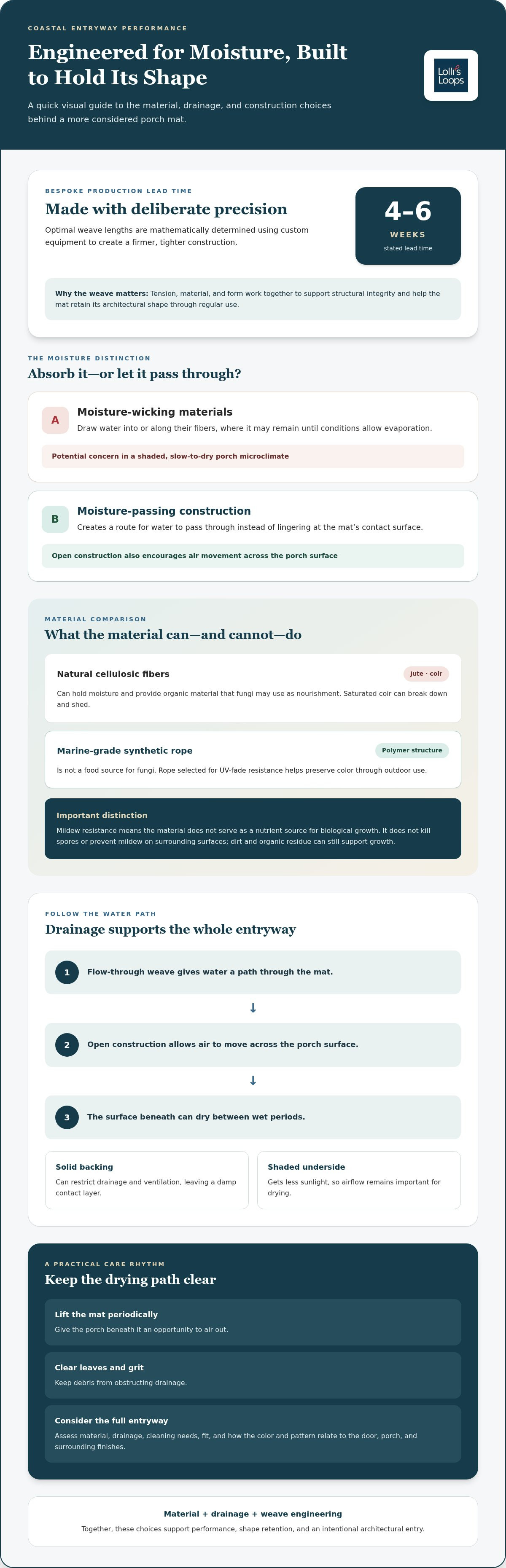
Moisture-wicking materials draw water into or along their fibers, where it may remain until conditions allow evaporation. Moisture-passing construction gives water a route through the mat and away from its contact surface. In a coastal setting, moving moisture onward and allowing air to circulate can be more useful than simply absorbing it.
Biological Growth vs. Synthetic Integrity
Mildew is a form of fungal growth. A general overview of mildew helps clarify why damp, poorly ventilated surfaces are vulnerable. Natural cellulosic fibers such as jute and coir can hold moisture and provide organic material that fungi may use as nourishment. Marine-grade synthetic rope takes a different approach: its polymer structure is not a food source for fungi, although dirt or other organic residue on a surface can still support growth.
Mildew resistance describes a material that does not serve as a nutrient source for biological growth. It does not mean spores are killed or that surrounding surfaces can never develop mildew.
Sunlight and UV exposure can help outdoor surfaces dry, and UV may limit some fungal development on exposed areas. But a mat’s underside is shaded, so airflow remains essential. A mildew resistant doormat should support drying throughout its structure rather than rely on sun alone.
The Drainage Imperative for Porch Health
When water is held against a porch, repeated dampness can contribute to staining or deterioration in vulnerable wood decking and architectural stone. A solid backing can restrict drainage and ventilation, creating a persistently damp layer where the mat meets the surface. That hidden contact zone is the microclimate to consider, not just the mat’s visible face.
A flow-through weave allows water to pass instead of pooling beneath the mat, while open construction encourages air to move across the porch surface. This helps the substrate dry between wet periods and supports its ongoing care. Lolli’s Loops’ marine rope Signature Stripe Doormat reflects this flow-through approach, pairing outdoor performance with considered entryway design.
For practical upkeep, lift the mat periodically so the porch beneath it can air out, and clear away leaves or grit that might obstruct drainage. Good material selection and simple attention to airflow work together. Neither a surface treatment nor a decorative mat can substitute for a drying path.
Engineering Beyond the Surface: Why Marine-Grade Materials Outperform
Rope has long served demanding work around working waterfronts, where exposure to weather is part of daily life. Its arrival at the home’s entrance brings that practical material into a more considered setting. For a coastal property, marine-grade construction pairs weather-tough rope with a structure designed to hold its form and complement the architecture.
UV exposure is one of the tests an outdoor mat must face. Sunlight can gradually fade materials, leaving the entryway looking worn even when the porch itself is beautifully maintained. Marine-grade rope selected for UV-fade resistance helps preserve color through outdoor use, making material choice part of curb appeal as well as performance. A rope mat also has a distinct, substantial hand compared with a conventional flat outdoor mat, with a defined woven texture underfoot.
Explore how the material’s maritime roots inform contemporary design in this marine rope Signature Stripe Doormat.
Mathematical Precision in Weave Construction
A rope mat’s resilience depends not only on the rope, but on how each length is worked into the whole. Lolli’s Loops mathematically determines optimal weave lengths using custom equipment, creating a firmer, tighter construction. This deliberate engineering supports structural integrity and helps the mat retain its architectural shape through regular use. It’s a considered balance of material, tension, and form.
That distinction matters over time. A mat that holds its structure continues to read as an intentional element of the entryway, rather than a temporary layer that has lost its definition. The aim is a carefully engineered foundation for lasting performance, not an unsupported promise of a fixed lifespan.
Performance Under Pressure: Heavy Traffic and Weather
Repeated foot traffic can compress a loosely constructed outdoor rug, flattening its surface and softening its edges. Heavy-duty marine-grade rope and a firmer weave are designed with durability in mind, helping the mat maintain a substantial presence at a busy threshold. Its weight and construction can also help it remain settled in exposed conditions, though placement and porch exposure affect how any mat behaves in strong winds.
For a deeper look at the relationship between rope construction and exposed entryways, read this guide to stability in high-wind zones. The same principles offer a useful lens for choosing a mildew resistant doormat: consider the material, the integrity of the weave, and how the finished piece will sit within the home’s architecture. Together, those decisions turn a practical threshold into an enduring architectural anchor.
The Coir Conflict: Why Natural Fibers Fail in High-Moisture Environments
Coir has a familiar, textured look and can catch grit at the doorstep. The difficulty begins when that natural fiber stays damp. Coconut husk fibers can absorb and retain moisture; in humid conditions, lingering wetness can encourage mildew and gradually compromise the material. Debris caught in a wet mat adds to the problem, leaving a musty odor and a surface that no longer feels clean or welcoming.
As the fibers wear, pieces can loosen and track across the threshold. A mat meant to intercept dirt may instead scatter its own fibers onto polished floors. Replacing a mat repeatedly can also mean more discarded material, while investing in a durable design may reduce that cycle. A mildew resistant doormat should be judged not only by what it catches, but by how it handles water, wear, and cleaning over time.
The Hidden Costs of Low-Resilience Materials
There’s no universal replacement schedule for coir mats. Exposure, drainage, and upkeep all affect how long one lasts. But when a mat sheds, holds odor, or loses its structure, replacement becomes a practical concern. Loose, coarse fibers can also act as grit underfoot, so regular sweeping at the entry helps protect interior flooring. Choosing resilient materials can help avoid treating a doormat as disposable seasonal decor.
Comparing Marine Rope and Coir
The materials behave differently in a damp entryway. These are general material characteristics, not a promise that a mat or the porch beneath it will never develop mildew.
| Material | Mildew Resistance | Shedding | UV Performance | Drainage |
|---|---|---|---|---|
| Coir | Organic fiber can retain moisture and support growth in persistently damp conditions | Fibers may loosen with wear | Outdoor exposure can weather natural fibers | Can hold moisture within the fiber structure |
| Marine-grade rope | Synthetic rope isn’t a nutrient source for fungi, though surface dirt can still support growth | Lolli’s Loops provides a non-shedding guarantee | Selected for UV-fade resistance | Flow-through construction lets water pass |
“Weatherproof” should account for cleaning as well as exposure. A washable mat can be cleaned when dirt accumulates, then allowed to dry, helping maintain a fresh threshold. Marine-grade rope combines practical upkeep with a considered, enduring appearance. For a closer look at the material trade-offs, read Lobster Rope vs. Coir Doormat: The Definitive Comparison.
Architectural Selection: Curating Performance and Curb Appeal
An entryway sets the tone before a guest crosses the threshold. Treat the mat as part of the architecture, not an afterthought: its color, pattern, and scale should relate to the door, surrounding trim, porch materials, and landscape. A mildew resistant doormat can meet a practical need while still serving as an intentional anchor for a carefully styled home.
Elevated Designs: Stripes, Waves, and Gradients
Start with the character of the facade. A classic stripe can bring measured rhythm to a traditional coastal home, while a captain’s stripe offers a crisp counterpoint to the clean lines of a minimalist porch. Wave patterns introduce a sense of movement, and gradients can echo the shifting tones of sea and shoreline. Choose colors in conversation with the home’s palette: sand and blue can soften a white exterior, while green can complement natural landscaping and wood details.
Thoughtful color curation keeps the mat from competing with architectural features. Browse the best-selling rope doormats for examples of patterns and coastal color combinations.
Scale for a Balanced Entrance
Proportion matters as much as pattern. A mat that feels undersized beneath double doors can make a generous entrance seem unfinished, while one that overwhelms the landing may crowd the surrounding details. Consider the full doorway width, available porch space, and door swing before settling on dimensions. A bespoke size can create a more balanced visual anchor where a standard mat doesn’t suit the architecture.
Stand back and assess the entry as a whole. The right scale should feel deliberate, with enough surrounding space for the mat’s woven texture and color to read clearly.
A Washable Investment, Made for Outdoor Living
Salt spray and sand are part of coastal life. A washable marine-rope mat can be refreshed with a garden hose, allowing surface grit to rinse away without turning routine care into a complicated task. Let the mat dry fully after cleaning, and keep the area beneath it clear so moisture and debris don’t linger. For a refined threshold that pairs enduring design with practical upkeep, explore Lolli’s Loops’ handcrafted marine rope doormats.
Choosing a mat for a distinctive entrance? Discuss a bespoke size for your porch and make proportion part of the design from the start.
Bespoke Craftsmanship: The Longevity of Mathematically Engineered Rope
A refined entryway deserves more than a mat chosen by default dimensions. Lolli’s Loops brings together marine-grade rope, handcrafted production, and a proprietary process that mathematically determines optimal weave lengths. The result is engineered for a firmer, tighter construction that supports the mat’s shape and gives it the presence of an architectural anchor.
Bespoke production takes time. The 4–6 week lead time reflects the care involved in making each mat to order. For homeowners, that wait is part of a considered investment: the focus is on material performance, precise construction, and a finish that belongs at the entrance.
From Workshop to Stoop: The Artisan Journey
Lolli brings hands-on attention to the making of marine-rope doormats. Handcrafting guides the work through each stage, while mathematical planning gives the weave a consistent structural foundation. It’s a meeting of manual artistry and deliberate engineering, not simply rope worked into a pattern.
Distinctive entryways may call for dimensions beyond a standard fit. A custom-size doormat can be tailored to the space, helping it sit in proportion with the doorway and porch. Rather than promising a mat will last as long as a house, the architectural-anchor philosophy is about choosing a durable, thoughtfully made piece that can serve the home beautifully over time.
Investing in First Impressions
The threshold is one of the first details guests encounter, and one homeowners see each time they return. A clean, well-proportioned mat contributes to a sense of welcome; a damp, shedding mat can distract from carefully chosen doors, paint, and hardscape. For discerning homeowners, performance and visual coherence matter more than a passing decorative flourish.
A mildew resistant doormat is one part of a considered entryway. Marine-grade rope, a close engineered weave, and practical washability bring function into step with refined design. The mat doesn’t need to call attention to itself. It should feel settled, enduring, and right for the architecture.
Explore the handcrafted marine rope doormats at Lolli’s Loops to find a considered design for your entryway.
Choose an Entryway Built for Coastal Living
A lasting porch mat begins with materials and construction suited to the elements. Marine-grade rope offers a weather-tough alternative to moisture-retaining natural fibers, while flow-through drainage and airflow help water move away from the mat and porch surface. Just as important, color, pattern, and proportion can make a mildew resistant doormat feel like an intentional part of your home’s architecture.
Lolli’s Loops brings these considerations together with proprietary mathematical engineering, artisan-made marine rope doormats, and a Non-Shedding Guarantee. Each mat is made to order and designed to hold its shape while bringing refined performance to a well-curated entrance.
Give your threshold the same thoughtful attention as the rest of your home. Explore a bespoke architectural entryway anchor and take the next step toward a more welcoming, coastal-ready porch.
Frequently Asked Questions
Are these doormats truly mildew resistant in humid coastal climates?
Marine-grade rope is designed to resist mold and mildew, including in humid coastal conditions. Its synthetic material doesn’t provide the same organic food source as natural fibers, and the flow-through weave helps water drain rather than remain trapped. Still, dirt and other organic residue on any outdoor surface can support growth. Rinse away buildup as needed and let the mat and porch beneath it dry.
Will a lobster rope doormat shed over time like coir?
Lolli’s Loops marine-rope doormats come with a Non-Shedding Guarantee, unlike natural coir fibers that can loosen and scatter as they wear. That means the mat is designed to catch dirt without adding loose fibers to your entryway. As with any outdoor mat, keep it free of accumulated grit and debris so it can continue to look considered and perform as intended.
How do I clean a mildew resistant doormat if it gets muddy?
Rinse the mat with a garden hose to wash away mud and surface debris. Marine-rope doormats are washable, and their flow-through construction allows water to pass through rather than collect inside a solid backing. After rinsing, allow the mat to dry and check that the porch surface beneath it can air out as well. Regular rinsing is especially useful after muddy or sandy conditions.
Can these mats be left uncovered on a patio year-round?
Yes. Lolli’s Loops mats are designed for outdoor use, including uncovered patios, and use weather-tough marine-grade rope selected for UV-fade resistance. Their flow-through construction lets water drain through the weave. Outdoor exposure varies, so periodic rinsing and allowing the mat and surface beneath it to dry can help keep the entry area fresh and the mat looking cared for.
What makes a mathematically engineered doormat different from a standard woven one?
A mathematically engineered mat is built around deliberately determined weave lengths, rather than relying on a general weaving pattern alone. Lolli’s Loops uses a proprietary process and custom equipment to create a firmer, tighter weave intended to support structural integrity and help the mat retain its shape. The result combines handcrafted artistry with a measured approach to construction.
Do these mats blow away in high winds or hurricanes?
Heavy-duty marine-grade rope and a substantial woven construction are intended to help the mat stay settled in exposed conditions, but no mat can be guaranteed to remain in place during hurricane-force winds. Wind strength, porch exposure, and placement all matter. Before severe weather, bring the mat indoors or store it in a sheltered location to prevent it from shifting or becoming airborne.
Is the rope soft enough for bare feet and pets?
Marine rope has a substantial, textured feel rather than the plush softness of a fabric mat. The surface is designed for durability and regular foot traffic, but comfort is personal, especially for sensitive feet or pets. If bare-foot use is important, consider how a firm woven texture will feel in your particular entryway and how your household typically uses the space.
How long can I expect a marine-grade rope doormat to last?
There isn’t a fixed lifespan that applies to every home. Exposure to sun, weather, foot traffic, and routine care all influence how a mat performs over time. Lolli’s Loops combines weather-tough marine-grade rope with mathematically determined weave lengths to support durability and shape retention, but this isn’t a guarantee of a specific number of years. Rinsing away debris and allowing the mat to dry can support ongoing care.