Doormat That Doesn't Shed: What to Look for in a Lasting Entryway Mat
What makes a doormat that doesn't shed different from one that simply looks tidy? Start with how its material is held together. Loose fibers can collect around a threshold, while dirt tracked in from outside is a separate issue. Knowing the difference helps you assess what a mat’s shedding claim actually promises.
This guide explains how material and construction relate to fiber retention, what to look for in a product description, and how to match a mat to your doorway, floor, and care routine. You’ll also find practical sizing and placement checks to make before choosing a design.
Lolli’s Loops mats are handwoven to order, one loop at a time, from reinforced, UV-enhanced marine-grade rope. Their engineered double-weave construction and hand-tensioned braid create a firm, composed surface, and each mat comes with a 100% non-shedding guarantee. Prolonged direct sun exposure may gradually change the rope’s color. These details make it easier to weigh performance alongside pattern, color, and fit.
Key Takeaways
- A doormat that doesn't shed is designed to retain its fibers during ordinary use. That is different from how well it collects dirt.
- Look beyond a broad “no-shed” label for clear information about material, construction, and any stated guarantee.
- Before choosing a mat, consider the threshold, foot traffic, floor surface, and care routine.
- Measure the doorway and available floor space, then account for the door’s swing when selecting a size.
- Material and construction details help you assess performance while choosing a design that suits your home.
What Does a Doormat That Doesn't Shed Actually Do?
Loose fibers at the threshold can undermine a carefully composed entrance: strands on the floor, even beside a clean step and a well-chosen door. The first step in choosing a replacement is working out whether the mess comes from the mat itself or from shoes bringing in outdoor debris.
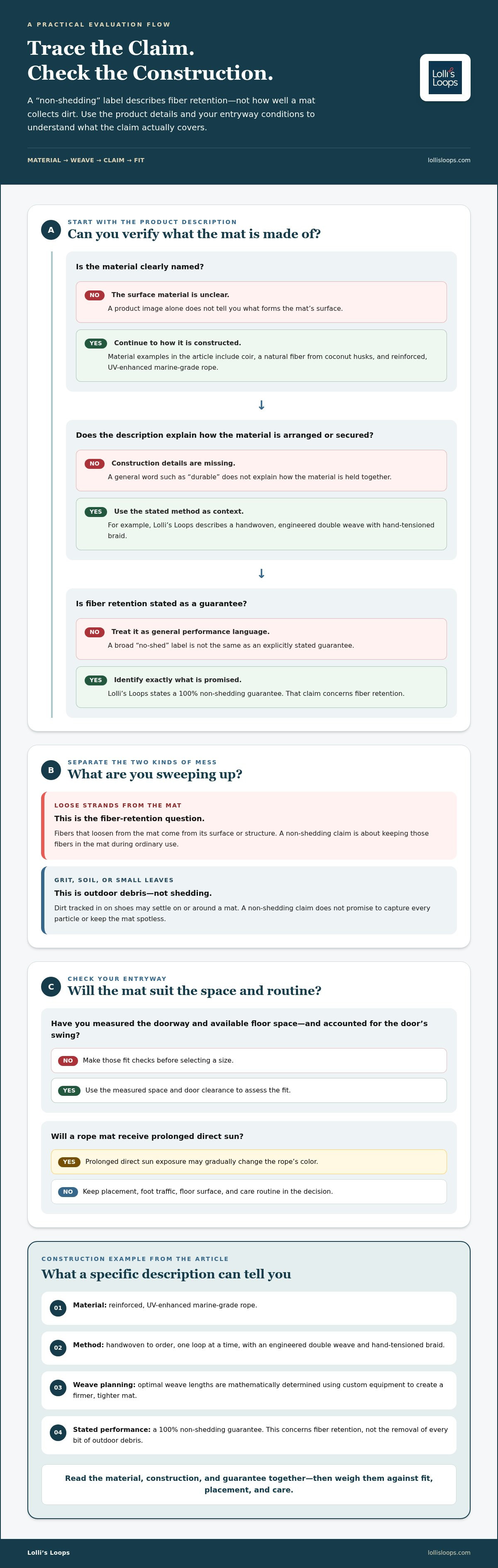
A non-shedding doormat is designed to retain its fibers during ordinary use, though it still needs routine care and may collect debris from outside. The claim describes what stays in the mat. It does not mean every grain of sand or fleck of leaf will be captured.
How doormat shedding differs from everyday debris
Look closely at what you’re sweeping up. Fibers that have loosened from the mat come from its surface or structure. Grit, soil, and small leaves tracked in on shoes come from outdoors and may settle on or around the mat. Both can gather at the threshold, but they point to different performance questions.
Loose strands can make an entry look untidy, especially against a contrasting floor or pale porch surface. Dirt removal is a separate function: a mat’s texture and form affect how it meets footwear and holds incoming particles. A non-shedding claim concerns fiber retention, not a promise that the mat will capture every particle or stay spotless.
Why a non-shedding claim needs construction context
The words “non-shedding” describe an intended result, but not what the mat is made from or how its material is secured. Look for both details in the product description. They give you a clearer basis for understanding how the surface is formed and what the claim refers to.
For general background on a mat’s purpose and common materials, see this overview of doormat materials and function. Then look for specific descriptions of material and construction rather than relying on a polished product image. Appearance alone doesn’t reveal how the elements of a mat are held in place.
For example, Lolli’s Loops’ Signature Stripe rope doormat is handwoven to order, one loop at a time, from reinforced, UV-enhanced marine-grade rope. Prolonged direct sun exposure may gradually change the rope’s color. These details explain the material and method behind the mat, alongside its 100% non-shedding guarantee.
Use material and weave as practical comparison points, not as blanket assurances about every mat in a category. Read the shedding claim alongside the construction details, and keep fiber retention separate from dirt removal. That makes it easier to judge whether a mat’s stated performance suits the entryway you want to maintain.
Why Material and Weave Matter in a Doormat That Doesn't Shed
A broad “no-shed” label gives you an outcome, but not the details behind it. Material and construction help explain how a mat is made and what its performance claim means. Compare the stated material and the way the surface is formed rather than relying on product photography or a short label.
Different materials have different surface qualities, so no single description tells the whole story for every entryway. Coir, for instance, is a natural fiber from coconut husks, and loose coir fibers are a familiar frustration for homeowners. The useful question is not simply which material sounds best. Look for an explanation of how the chosen material is secured and how the mat is intended to perform.
A mat’s shedding performance depends on its material and construction, not appearance alone. A tidy-looking surface may suit your porch, but visual appeal by itself doesn’t show how securely its fibers are held in place.
Lolli’s Loops makes its mats from reinforced, UV-enhanced marine-grade rope. The rope is hand-tensioned into an engineered double weave designed to resist curling and sagging. Each mat is handwoven to order, one loop at a time, bringing deliberate construction together with considered pattern and color.
The weave is planned, not left to chance. Lolli’s Loops mathematically determines optimal weave lengths using custom equipment to create a firmer, tighter mat. That gives you a concrete construction detail to consider, rather than a general claim such as “durable.” The rope is UV-enhanced, but prolonged direct sun exposure may gradually change its color, so factor placement into your choice.
When comparing rope mats, consider the material and how it is worked together. Material establishes the surface, while construction shapes how that surface holds its form. Read the product details to understand what the maker designed the mat to do, then weigh those details against your entryway’s needs.
Explore the construction and design of Lolli’s Loops rope doormats and choose the style that suits your entrance.
How to Evaluate a Doormat That Doesn't Shed Before You Choose
A polished surface can catch the eye, but it won’t tell you how the mat is made or what a shedding claim means. Read the product description for details you can compare: material, construction, stated performance, placement, and care. That shifts the decision from trusting a broad label to understanding what the maker says.
| What to check | What a useful description tells you | Why it matters |
|---|---|---|
| Material | Names the mat’s material clearly. | Lets you understand what forms the surface instead of guessing from a photo. |
| Weave or construction | Describes how the material is arranged or secured. | Offers more context than a general word such as “durable.” |
| Shedding statement | Distinguishes a stated guarantee from general performance language. | Clarifies whether fiber retention is explicitly promised. |
| Intended placement | Indicates whether the mat is intended for indoor or outdoor use. | Helps you compare the product with its planned location. |
| Care instructions | Explains the recommended routine. | Lets you judge whether upkeep suits your household. |
Questions to ask of material and construction claims
Start with the material name. Then look for an explanation of how the surface is formed, not just adjectives such as “strong” or “long-lasting.” Finally, read the shedding language closely. “Designed to resist shedding” describes an intention; a specific non-shedding guarantee is a more direct commitment. Neither means the mat captures every speck of dirt or needs no care.
Specific construction details are more useful than an attractive close-up. A description that names a weave or explains how its elements are held together gives you a clearer picture of the mat. If the product page focuses only on appearance, you have less information to assess fiber retention.
Match performance details to the entryway
Consider where the mat will sit before choosing. An interior threshold and an exposed outdoor entrance have different conditions, so check that the stated placement suits your intended location. Think about how often the doorway is used, too. At a busy threshold, clear care instructions matter because a mat may collect ordinary debris even when its fibers stay in place.
For Lolli’s Loops mats, care means shaking out loose debris or rinsing with a garden hose, then allowing the mat to air-dry fully. Prolonged direct sun exposure may gradually change the rope’s color, so consider placement when choosing a color combination.
Use appearance as the final layer of the decision, not the only one. Color and pattern should complement your entry’s architecture, while material, construction, and care details support daily use. A mat that brings those considerations together can feel like a deliberate part of the home, rather than a purely functional afterthought.
Fit a Non-Shedding Doormat to Your Entryway and Routine
A mat should feel at home in its setting, not simply fit the space on paper. Before choosing a doormat that doesn't shed, follow a practical sequence: identify the threshold, consider foot traffic, assess the floor surface, and review care requirements. This helps align the mat’s intended placement with the way your household uses the entrance.
A simple entryway-fit checklist
- Identify the threshold. Decide whether the mat will sit at a front door, back door, or uncovered patio. Note how exposed the entrance is, then confirm the product’s stated indoor or outdoor use suits that location.
- Consider daily traffic. Think about how often people use the doorway and whether it’s a primary entrance or a quieter passage. Choose a care routine you can manage, especially for a frequently used threshold.
- Assess the surface. Notice whether the mat will rest on a smooth indoor floor or another kind of surface. For indoor use on smooth surfaces, use a rug pad for added grip.
- Measure the available space. Measure the doorway and the area where the mat will sit. Account for the door’s swing and surrounding threshold so the mat fits comfortably without crowding the entrance.
- Check care requirements. Read the care instructions and decide whether they suit the location and your routine. The right choice should be practical to maintain as well as visually composed.
These steps work together. A mat selected for an uncovered patio may face different conditions from one placed just inside a sheltered front door. A broad entrance may suit a larger mat, while a narrower threshold calls for a more tailored fit. Measure rather than relying on visual impression, and compare the product’s stated use with the planned placement.
Keep upkeep simple and specific
Know the care routine before the mat arrives. For Lolli’s Loops mats, shake out loose debris or rinse with a garden hose, then allow the mat to air-dry fully. Keep this routine in mind as you consider where the mat will sit and how it fits your schedule.
Design belongs in the decision, too. Once you’ve considered the threshold, traffic, surface, size, and care routine, look at how color and pattern relate to the door, flooring, and surrounding architecture. A thoughtfully chosen entryway mat can anchor the space while serving a practical purpose. Explore Lolli’s Loops doormats to find a style and size for your entrance.
Lolli's Loops: A Handwoven Doormat That Doesn't Shed
For homeowners seeking a composed entrance and a clear answer to loose fibers, Lolli’s Loops brings material, construction, and design together in hand-woven rope mats. Made from reinforced, UV-enhanced marine-grade rope, each mat is handwoven to order, one loop at a time, and comes with a 100% non-shedding guarantee. It’s a considered entryway accent with a defined material and construction behind its performance claim.
The construction behind the non-shedding guarantee
The rope is hand-tensioned into a heavyweight marine braid and an engineered double-weave construction designed to resist curling and sagging. Its tight structure supports the non-shedding promise. Rope ends are melt-finished for a clean finish that complements the mat’s architectural presence.
This construction is engineered, not simply woven by eye. Custom equipment helps determine optimal weave lengths for a firmer, tighter mat. The result pairs a hand-woven surface with a deliberate structure. Explore the artisan-made doormat article to learn more about hand-woven workmanship.
Specifications and design for a considered entrance
Choose from standard dimensions of 19 × 32, 22 × 36, 22 × 40, and 24 × 50 inches. Custom sizing is available up to 72 inches long × 30 inches wide. Measure the intended space before selecting a size, and consider how the mat’s scale will sit against the door and surrounding architecture.
Weight is approximately 8-10 lb, depending on size, and thickness is approximately 1-1½ in, with minor variation between individually woven mats. These measurements help you assess the mat’s profile and how it may sit near your doorway.
Color and pattern complete the decision. Thoughtfully curated combinations and wave-like designs bring a measured note of movement to the porch, while the material and construction provide practical detail. The rope is UV-enhanced, though prolonged direct sun exposure may gradually change its color, so consider placement when choosing a design.
Choose a Signature Stripe Doormat or explore the other handwoven-to-order designs at Lolli’s Loops to find a considered fit for your threshold.
Make the Threshold Feel Intentionally Yours
Your entryway sets the tone before a guest crosses the threshold. The right mat can bring proportion, texture, and color into alignment with the architecture around it. Look beyond what you want to keep off the floor: consider the first impression you want the doorway to make, then choose a design that belongs in the space.
A lasting choice should offer confidence in both appearance and construction. Lolli’s Loops backs its mats with a three-year warranty for craftsmanship and structural integrity. That assurance reflects the care invested in each handwoven piece.
Take your measurements and consider the character of your entrance. Lolli’s Loops mats are handwoven to order, one loop at a time, from reinforced, UV-enhanced marine-grade rope. Choose a Signature Stripe Doormat to give your entryway a considered welcome.
Frequently Asked Questions
Is every rope doormat non-shedding?
No. Rope alone doesn’t establish how securely a mat’s fibers are held or whether the maker stands behind a shedding claim. Assess a doormat that doesn't shed by its stated material, construction details, and performance commitment, rather than by the word “rope” or a close-up image. A clearly stated guarantee is more specific than broad language about durability, which may refer to other aspects of the mat.
Can a non-shedding doormat still trap dirt?
Yes. Fiber retention and dirt removal are separate qualities, so a mat can be designed to retain its own fibers while collecting grit from shoes. Soil tracked in from a garden, for example, may sit on or around the mat without coming from its construction. Expect to remove ordinary debris as part of routine care.
Can a rope doormat be used indoors and outdoors?
Yes, Lolli’s Loops mats are suitable for indoor or outdoor entryways. For indoor use on smooth surfaces, use a rug pad for added grip. Consider the exact placement before choosing: a mat just inside a front door may rest on a smooth floor, while one at a back entrance may meet a different surface.
Does UV-enhanced marine-grade rope ever change color?
Yes. Although the rope is UV-enhanced, prolonged direct sun exposure may gradually change its color. Keep this in mind if you’re choosing a mat for a threshold that receives strong sunlight for much of the day. Placement can affect how the color combination looks over time.
Does a heavier doormat necessarily shed less?
No. Weight alone doesn’t establish how well a mat retains its fibers. A substantial mat may feel anchored underfoot, but shedding performance depends on the material and how the mat is constructed. Compare those details and the maker’s specific shedding statement instead of treating weight as a proxy. Weight can still help you understand the mat’s presence and handling when positioning it at the threshold.
How thick is a hand-woven rope doormat?
Lolli’s Loops rope mats are approximately 1-1½ in thick, with minor variation between individually woven mats. Consider the available clearance and how the door opens when choosing where to place the mat. The measurement is approximate, so not every individually woven mat will have an identical thickness.
Can I order a doormat in a custom size?
Yes. Lolli’s Loops offers custom sizing up to 72 inches long × 30 inches wide. Measure the area where the mat will sit, including the space needed for the door to open, before settling on dimensions. A tailored size can help the mat feel proportionate to a broad entrance or fit a specific threshold within the stated sizing limit.