

Choosing the Most Durable Beach House Doormat: The Driftwood Portfolio Buying Guide
The classic coir mat you've always used is likely the secret enemy of your coastal entryway. While natural fibers feel traditional, industry data shows that 95% of coir mats deteriorate within just 18 months in rainy, salt-heavy regions. You need a durable beach house doormat that reflects the soul of your home, not a soggy, shedding mess that tracks sand deep into your sanctuary. It's frustrating to watch vibrant colors fade under intense UV rays or deal with trapped moisture that invites mildew on your porch.
This guide will show you how to select a coastal entryway solution that withstands salt, sand, and sun while remaining effortless to maintain. We'll explore the technical precision of solution-dyed fibers and the beauty of breathable, hand-woven construction. You'll learn how to find a unique, permanent piece that neighbors won't have, ensuring your home remains a curated sanctuary from the very first step. Discover how marine-grade engineering can be disguised as fine art to protect your floors for years to come.
Key Takeaways
- Understand why traditional natural fibers like coir succumb to salt air and how to avoid the hidden mess of shedding materials.
- Discover the structural advantages of marine-grade rope and why new, reinforced fibers outlast degraded recycled alternatives.
- Learn to select a durable beach house doormat that balances rugged industrial utility with the organic, non-symmetric beauty of the Driftwood Portfolio.
- Master the nuances of threshold sizing and door swing clearance to ensure a seamless, professional fit for your coastal entrance.
- Adopt simple, efficient care rituals like the "lift and sweep" method to maintain a hygienic, sand-free sanctuary.
Why Standard Doormats Fail in Coastal Environments
Coastal living demands a deep respect for the elements. We build with cedar, stainless steel, and stone because we know the sea eventually claims everything else. Yet, many homeowners still guard their thresholds with standard, mass-produced mats that aren't fit for the task. These products often rely on natural fibers or cheap adhesives that surrender to the environment within months. Choosing a durable beach house doormat isn't just about aesthetics; it's about finding a material that refuses to degrade under the weight of the tide and the heat of the noon sun.
The Coir Conflict: Sand, Rot, and Shedding
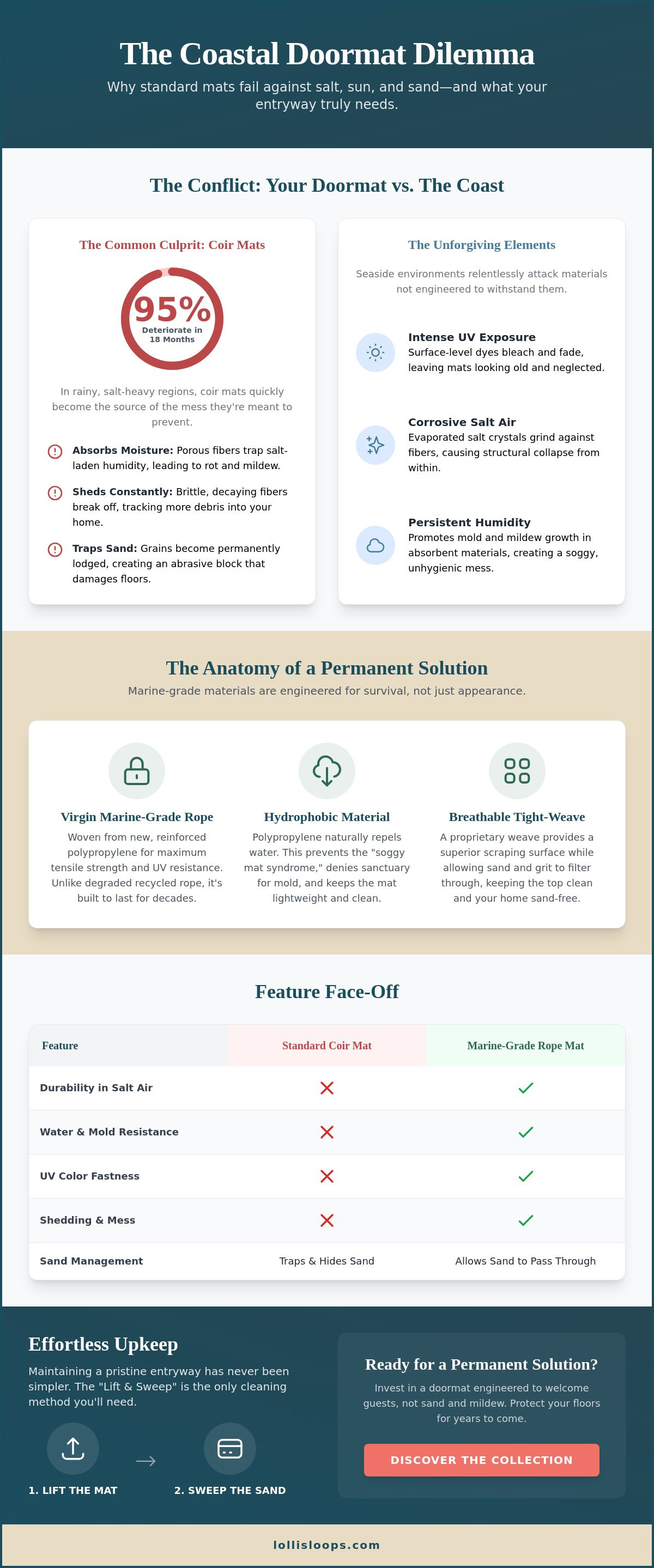
The most common mistake is the coir mat. While coconut husk fibers are often listed among durable doormat materials for inland homes, they are a liability at the shoreline. Coir is inherently porous. It drinks in the salt-laden humidity of the coast and refuses to let go. This constant state of saturation triggers a slow, organic rot. The fibers become brittle. They shed. Industry research indicates that in rainy regions, 95% of coir mats deteriorate within 18 months, proving their seasonal nature. The mat becomes the primary source of debris rather than the solution. The vertical orientation of coir bristles creates a permanent trap for sand. Once grains settle at the base, they're nearly impossible to remove, turning your doormat into a heavy, abrasive block that damages the very floors you're trying to protect.
Salt and Sun: The Silent Finish-Killers
Seaside light is beautiful but brutal. Standard doormats often use surface-level pigments that aren't integrated into the fiber itself. Under intense UV exposure, these colors bleach and fade. This "beach house fatigue" turns a welcoming entryway into a sign of neglect. Beyond the color, the salt itself acts as a mechanical destroyer. When salt water evaporates, it leaves behind sharp crystals. These crystals settle deep into the weave of cheap mats. With every step, these microscopic shards grind against the fibers, causing structural collapse from within. Even the backings fail. Standard rubber backings often crack and crumble when exposed to the extreme temperature shifts of a sun-drenched porch, leaving behind a stained residue on your decking. A true coastal solution requires a material that treats the environment as a partner, not an adversary.
The Anatomy of a Durable Beach House Doormat
True durability begins with a material's origin story. Marine-grade lobster rope wasn't designed for aesthetics; it was engineered for survival in the North Atlantic abyss. This rope had to withstand crushing pressures, constant submersion, and the corrosive bite of salt water. When we repurpose this industrial strength for the home, we create a durable beach house doormat that treats the threshold as a serious line of defense. The secret lies in the fiber's refusal to compromise, even when the environment is at its most hostile.
There is a critical distinction between "recycled" rope and the new, reinforced rope used in premium craftsmanship. While the idea of using old fishing gear is romantic, rope that has already spent years at sea has lost its structural integrity. The salt has already crystallized in its core. The sun has already begun to break down its molecular bonds. For a mat to last decades rather than seasons, it must be woven from virgin marine rope. This ensures the fibers possess their full tensile strength and original UV resistance from the moment they arrive at your door.
Marine-Grade Rope: Engineered for the Atlantic
The core of this durability is high-quality polypropylene. This material is naturally hydrophobic. It doesn't just resist water; it repels it. This prevents the "soggy mat syndrome" that plagues coir and cotton alternatives. Given the volatile weather patterns recorded through May 2026, including increased coastal humidity and sudden storm surges, this moisture resistance is non-negotiable. Because the rope cannot absorb liquid, it provides no sanctuary for mold or mildew. It remains light, clean, and stable regardless of the rainfall. You can see this resilient engineering in every Signature Stripe doormat we produce, where performance and heritage meet.
The Proprietary Tight-Weave Advantage
Construction is just as vital as material. A loose braid might look coastal, but it lacks the backbone to survive heavy foot traffic. It eventually flattens, loses its shape, and becomes a tripping hazard. A proprietary tight-weave construction creates a structural masterpiece that stays anchored. This density provides a superior scraping surface that catches sand and grit before it enters your sanctuary. Despite its firmness, the weave remains breathable. It allows air to circulate and sand to filter through to the ground below. This keeps the surface of the mat clean and ensures it feels substantial yet comfortable under summer bare feet. It's a balance of rugged utility and refined artistry that transforms a simple entryway into a curated space.
The Driftwood Portfolio: Where Art Meets Utility
Artistry meets muscle. It's a rare pairing. Most coastal decor relies on rigid, predictable patterns that feel more like a uniform than a personal choice. The Driftwood Portfolio rejects this industrial monotony. It positions the durable beach house doormat as a piece of functional art, curated for those who view their entryway as a gallery of their lifestyle. We've moved beyond the utility of standard rope mats into a space where organic, non-symmetric design takes center stage. In 2026, the discerning homeowner is replacing sterile symmetry with fluid, intentional compositions that mirror the natural world.
This collection is an homage to the shoreline itself. It draws inspiration from the textures of sun-bleached timber and the scattered beauty of tidal debris. By stepping away from the "perfect" stripe, we create a sense of movement and permanence. These mats don't just sit at your door; they anchor your home to its environment. They provide a sophisticated transition from the wild elements of the beach to the refined sanctuary of your interior.
Once inside that sanctuary, you can truly unwind, perhaps by enjoying a quiet morning with a word puzzle and using Letterpilesolver.com to help you solve anagrams and discover new word combinations from your letters.
Non-Symmetric Rows and Organic Palettes
Our design philosophy centers on breaking the traditional mold. Instead of repetitive, identical lines, we utilize non-symmetric rows that create a visual cadence. This isn't just an aesthetic choice; it's a practical one. Organic patterns are naturally better at masking the inevitable traces of coastal life. While a perfectly symmetric mat highlights every stray grain of sand, our Driftwood-inspired palettes of muted tans, weathered greys, and sea-glass teals swallow the mess. These colors aren't just surface deep. They're integrated into the UV-stabilized fibers to ensure the sea-glass teal you love today remains just as vibrant after a summer of intense salt air exposure.
Standout Products in the Driftwood Collection
Each piece in this portfolio tells a different story of the sea. The Wave Pattern Doormat is a favorite for homes with fluid architectural lines, offering a rhythmic, undulating weave that captures the spirit of the Atlantic. For those who prefer a nod to tradition with a modern twist, our Signature Stripe Doormat provides a subtle shift in color that feels both familiar and bespoke. Because each mat is hand-woven by master artisans, no two are ever identical. You aren't just buying a floor covering; you're commissioning a unique entryway solution. This handcrafted nature ensures your threshold is guarded by a piece of equipment that neighbors simply won't have, blending the rugged legacy of marine rope with the soulful energy of contemporary design.
How to Choose: Sizing and Styling Your Coastal Entrance
A threshold is more than a transition; it's a statement of intent. Selecting a durable beach house doormat requires a balance of mathematical precision and aesthetic intuition. You're looking for a piece that anchors the house, providing a sense of permanence against the shifting sands. Proportion is the first rule of the artisan. A mat that's too small feels like an afterthought, while one that's too large can swallow the architectural detail of your siding. It's about creating a frame that welcomes guests into your curated sanctuary.
To find the ideal fit, follow these four foundational steps:
- Measure with intent: Your mat should be wide enough to leave roughly 1 to 2 inches of clearance on either side of the door frame. This creates a framed, intentional look that feels custom to the space.
- Check the swing: Marine rope is substantial and thick. Measure the gap between the bottom of your door and the porch floor to ensure the weave clears the swing without catching.
- Anchor your palette: Choose colors that bridge the gap between your door's paint and the exterior siding. Driftwood greys anchor lighter homes, while sea-glass teals provide a spirited pop against traditional white trim.
- Go bespoke: If your entryway has non-standard dimensions, a Custom Size doormat ensures the proportions remain harmonious with your home’s unique architecture.
Finding the Perfect Fit for Single and Double Doors
Scale is often where standard retail options fail. A typical 18" x 30" mat looks lost and fragile when placed before a grand double-door entrance. It fails to serve the visual weight of the home. For these larger thresholds, we recommend moving beyond standard dimensions. An oversized or custom piece provides the necessary scraping surface for high-traffic coastal families while maintaining a premium, high-end feel. For a deep dive into specific measurements and how to avoid a "lost" mat, consult our guide on Choosing the Right Doormat Size for Double Doors.
Coordinating with Coastal Home Aesthetics
Your doormat is the handshake of your home. It should signal the style that waits inside. The muted, organic tones of the Driftwood Portfolio perfectly complement the "Coastal Grandma" aesthetic or the clean lines of "Modern Nautical" design. It acts as a bridge, pulling the natural textures of the landscape into your home. There's also a psychological comfort to a heavy, anchored mat. During the violent winds of a coastal storm, a flimsy mat will skitter across the porch or vanish entirely. A hand-woven rope mat stays grounded. It provides a sense of stability and legacy that lighter alternatives simply cannot match. If you're ready to secure your entrance, you can explore our Solid Color doormats to find the perfect anchor for your specific siding.
Longevity and Care: Making Your Investment Last
A true artisan piece doesn't just arrive; it endures. When you invest in a durable beach house doormat, you're moving away from the cycle of seasonal disposal. Maintenance is no longer a chore involving vigorous shaking or frustrated scrubbing. It becomes a simple, rhythmic ritual that preserves the integrity of the weave. Because marine rope is inherently hygienic and non-absorbent, it doesn't harbor the bacteria or damp odors common in natural fiber alternatives. It’s a permanent solution for a home that values both form and function.
Sand is the primary adversary of any coastal threshold. While traditional mats trap grit deep within their fibers, a hand-woven rope mat utilizes a "lift and sweep" method. Simply lift the mat, sweep away the sand that has filtered through the breathable weave, and set it back in place. It's efficient. It's clean. For deeper care, the 2026 standard for outdoor textile maintenance favors a simple application of mild soap followed by a pressurized rinse. Unlike fragile coir, these mats are built to withstand the force of a power washer, emerging from the process looking as vibrant as the day they were first unrolled.
Maintenance and Cleaning Made Simple
Refreshing your entryway takes only minutes. Follow these steps to maintain your mat’s seafaring luster:
- Rinse: Use a garden hose or power washer to blast away salt spray and surface dust.
- Soap: Apply a gentle detergent to any stubborn spots; the polypropylene fibers won't hold onto stains.
- Dry: Prop the mat against a railing. It dries in minutes because the rope doesn't soak up water.
This rapid-dry capability prevents the "damp porch" smell that often plagues coastal homes. Unlike coir, lobster rope maintains its mass and integrity indefinitely, never leaving a trail of fibers in your foyer. You don't need to hide these mats when winter storms roll in or when the salt spray turns heavy. They're engineered to stay grounded and beautiful through every season.
Securing Your Driftwood Portfolio Selection
The Driftwood Portfolio represents the peak of coastal engineering disguised as fine art. It offers a unique combination of organic design and industrial-grade resilience that standard retail mats cannot match. Before you finalize your selection, run through this brief checklist to ensure a perfect fit for your sanctuary:
- Size: Have you confirmed the 1-2 inch clearance on each side of your threshold?
- Clearance: Will the thick, rugged weave clear your door’s bottom edge?
- Palette: Does the color bridge the transition between your landscape and your interior?
Choosing the right mat is about more than just keeping floors clean; it's about anchoring your home’s identity. Explore the Driftwood Portfolio and elevate your coastal entryway today.
Secure Your Sanctuary’s Threshold
Every piece is handcrafted in Southport, NC. We use only UV-stabilized, marine-grade rope to ensure your entryway remains vibrant and mold-resistant for years. These mats don't shed. They don't rot. They simply endure. By choosing the correct scale and an organic palette, you transform a simple transition into a curated experience. It's time to move beyond the cycle of disposable mats. Invest in a legacy for your shoreline home. Shop the Artisan-Crafted Driftwood Portfolio and discover a work of functional art that welcomes you home through every season.
Frequently Asked Questions
What makes a doormat "durable" for a beach house?
True durability in a coastal environment is defined by a material's inherent resistance to moisture, salt, and UV degradation. A durable beach house doormat must be non-porous to prevent rot and utilize solution-dyed fibers to maintain its color. Look for materials that meet industrial standards like ASTM C501 for wear resistance. This ensures the mat survives the constant abrasion of sand without structural collapse.
Do lobster rope doormats shed like coir mats?
No, marine rope is non-shedding because it is crafted from continuous synthetic fibers rather than brittle plant husks. Unlike coir, which research shows can deteriorate within 18 months in wet coastal regions, lobster rope maintains its mass. It won't leave a trail of messy fibers in your foyer or lose its scraping effectiveness over time. It is a clean, permanent solution for your threshold.
Are these mats heavy enough to stay put in high winds?
The weight and density of hand-woven rope ensure these mats remain anchored during intense coastal storms. The proprietary tight-weave construction creates a substantial, heavy mat that resists skittering across a porch. Unlike lightweight rubber or synthetic turf products, these mats are engineered to stay grounded against the volatile gusts common in shoreline environments. They provide a sense of stability and legacy.
Can I use a power washer on a Driftwood Portfolio doormat?
You can safely use a power washer to refresh your mat. The industrial-grade polypropylene is built to withstand high-pressure rinsing, allowing you to blast away salt spray and trapped sand in seconds. Because the rope is hydrophobic, it won't absorb water or develop the damp, mildewed smell associated with traditional natural fiber mats. It dries in minutes, ready for the next guest.
How long does a marine-grade rope doormat typically last?
A high-quality marine rope mat is designed for permanence, often lasting many seasons longer than the typical 18-month lifespan of coir. While specific longevity depends on traffic and environment, the use of virgin marine-grade fibers ensures the mat won't crumble or rot. Regular cleaning can extend the life of synthetic doormats by up to 40%. It is a long-term investment in your home's protection.
Will the colors in the Driftwood Portfolio fade in direct sunlight?
These mats are crafted from UV-stabilized rope where pigments are integrated at a molecular level. While many "fade resistant" labels rely on temporary surface coatings, our solution-dyed fibers are built to withstand intense exposure. This process ensures the muted tans and sea-glass teals remain vibrant even under the relentless glare of the seaside sun. Your entryway will maintain its curated, artistic feel for years.
Is the rope soft enough to walk on with bare feet?
The weave is designed to be firm yet comfortable for summer living. While it provides the necessary scraping power to remove up to 80% of debris, the rope remains smooth and tactile. It offers a stable, supportive surface that feels substantial underfoot. It lacks the prickly, abrasive texture found in coir or cheap synthetic bristles, making it ideal for barefoot coastal lifestyles.
How do I choose the right size for a double front door?
For a double door, avoid standard 18" x 30" mats which will look undersized and lost. We recommend an oversized or Custom Size doormat that spans the width of both doors with 1 to 2 inches of clearance on each side. This provides a balanced, architectural frame that anchors your entryway. It ensures a professional, bespoke appearance that matches the grand scale of your home's architecture.

Article by
Mary Mooney (Lolli)