All-Weather Doormat Guide: Performance, Materials, and Entryway Fit
A “weatherproof” label doesn’t tell you how a mat will fare on an exposed porch. A true all weather doormat earns its place through the relationship between material, construction, drainage, placement, and care.
Sun, rain, and steady foot traffic can test a mat’s color, shape, and surface, while a poor fit can leave an entryway looking unfinished. The right choice balances lasting performance with the considered style of your home.
This guide explains how to assess the features that matter, match a mat to your doorway and its exposure, and choose a design with enduring curb appeal. We’ll look at how materials respond to weather, why weave and drainage matter, and how sizing and placement influence everyday use. Lolli's Loops’ marine-grade rope mats combine a tight, engineered weave with a design that lets water drain through. The result is a practical, purposeful welcome at the threshold.
Key Takeaways
- Assess your entrance’s exposure and foot traffic before choosing an all weather doormat, so its material and construction suit the conditions it will face.
- Compare mats by drainage, shedding, sun resistance, upkeep, and appearance instead of relying on broad weatherproof claims.
- Consider material and weave together to understand how a mat manages moisture and maintains its structure.
- Choose a size and design that feel balanced at your doorway, considering uncovered and sheltered placements separately.
- Explore how an engineered marine-rope mat pairs outdoor performance with considered color and pattern for lasting curb appeal.
What an All-Weather Doormat Needs to Handle at an Outdoor Entrance
An outdoor doormat faces the elements as well as regular entryway use. At the front door, that can mean rain, direct sunlight, repeated foot traffic, and shifting moisture levels. An all weather doormat should suit the conditions at its specific entrance, not just carry a reassuring label.
Performance depends on the whole arrangement: material, construction, placement, and care. A recessed porch and an uncovered doorstep experience different patterns of sun and rain, though both may see steady foot traffic. The history and function of doormats offers useful context, but choosing for outdoor use calls for attention to current exposure and specific product features.
Which outdoor conditions matter most at the front door?
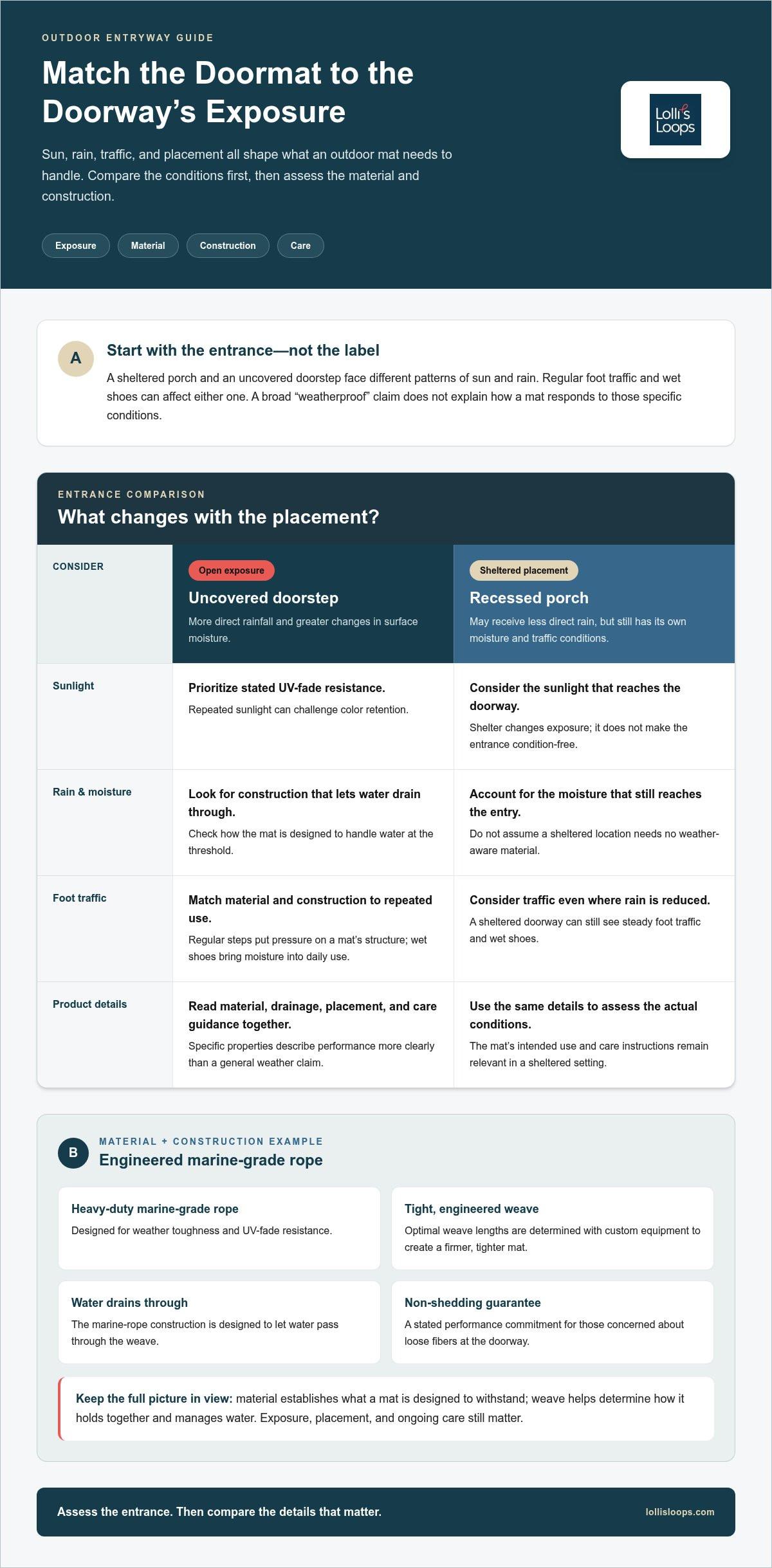
Start by observing the entrance. A sheltered doorway may receive less direct rain, while an uncovered one gets more rainfall and greater changes in surface moisture. Sun matters too: repeated exposure can challenge color retention, so stated UV-fade resistance is more useful than a general promise of durability.
Next, consider how often people enter and leave. Repeated steps put pressure on a mat’s structure, while wet shoes bring moisture into daily use. Look for materials and construction suited to the combination your doorway experiences. Heavy-duty marine-grade rope, for example, is designed for weather toughness and UV-fade resistance. A marine-rope Signature Stripe doormat brings those material qualities to an entryway with a considered color design.
How to read weatherproof claims with care
Broad terms such as “weatherproof” can leave important questions unanswered. Look for stated properties that relate to your conditions: a material’s UV-fade resistance, whether water drains through the construction, and how the mat should be placed and cleaned. These specifics describe performance more clearly than a label alone.
All-weather performance means a mat is suited to its intended outdoor exposure and regular use, with appropriate care. It doesn’t mean indestructible or maintenance-free. Dirt and debris can still collect, and care instructions remain relevant.
- For open exposure: Prioritize stated resistance to sunlight and construction that allows water to drain.
- For a sheltered entry: Consider the moisture and traffic that still reach the doorway rather than assuming it needs no weather-aware material.
- For any placement: Read the product’s care and use guidance alongside its material claims.
A well-chosen mat should suit the conditions at the threshold and feel at home in the entryway. Assess the exposure first, then weigh material, construction, and care as one decision.
How Material and Weave Shape All-Weather Doormat Performance
A mat’s material and construction work together. The rope or fiber affects how it responds to sunlight and weather, while the weave influences structure and how water moves through it. Considering either feature alone leaves out part of the performance picture.
Lolli's Loops uses heavy-duty marine-grade rope engineered for weather toughness and UV-fade resistance. The construction is engineered too: optimal weave lengths are determined with custom equipment to create a firmer, tighter mat. This precision supports structural integrity and shape retention, giving an all weather doormat a considered foundation beyond its surface appearance.
For a closer look at the material and its design context, explore this definitive lobster-rope doormat guide. It offers further perspective on how rope can serve both the practical role and visual presence of an entryway mat.
Why drainage and a tight weave belong in the same conversation
A tight weave and effective drainage may seem at odds. Lolli's Loops’ marine-rope construction is designed so water drains through the weave. That’s a specific functional feature, not a promise that every moisture issue disappears or that the surface and surrounding entryway need no attention.
Water that passes through a mat is handled differently from water held in a solid surface, but the entrance itself, its exposure, and ongoing care remain part of the picture. Look for a clear description of the mat’s construction, then consider that feature alongside its placement and care guidance.
What non-shedding and fade resistance mean in practice
Lolli's Loops mats come with a non-shedding guarantee. That assurance matters if loose fibers at the doorway are a concern. It’s a specific performance commitment, rather than a claim about unrelated forms of wear or damage.
Marine-grade rope is UV-fade resistant, not immune to every possible color change under every condition. Resistance describes a material property, while results can vary with exposure and use. For a homeowner, it provides a useful basis for comparing materials intended for outdoor placement.
Material establishes what a mat is designed to withstand, while weave helps determine how it holds together and manages water at the threshold. Lolli's Loops pairs marine-grade rope with a tight, engineered construction to support these outdoor functions. Explore the Lolli's Loops collection to see how those material and weave choices can suit your entrance.
Compare All-Weather Doormat Options by Performance and Entryway Needs
A useful comparison separates what a mat is made from, what its construction is designed to do, and what the product description states. The table below is a starting framework, not a universal ranking: performance varies by product. For coir, a separate lobster rope and coir doormat comparison offers more focused context.
| Option | Drainage | Shedding | Sun exposure | Upkeep | Appearance |
|---|---|---|---|---|---|
| Marine-grade rope | Water drains through Lolli's Loops' weave | Lolli's Loops mats have a non-shedding guarantee | UV-fade resistant | Can be hose-cleaned | Rope texture, stripes, and wave-like patterns |
| Coir | Can retain moisture; drainage depends on construction | Coir can shed fibers with use | Sun exposure can affect color over time | Follow the individual product’s care guidance | Natural fiber texture |
| Rubber-backed mat | A backing may limit drainage through the mat | Shedding depends on the surface material | Sun resistance depends on the materials | Follow the individual product’s care guidance | Styles and surface textures vary |
| Synthetic mat | Depends on the weave, backing, and overall construction | Depends on the fibers and construction | Sun resistance varies by material | Follow the individual product’s care guidance | Colors, textures, and patterns vary |
Material names alone don’t establish how a particular mat drains, sheds, or responds to sunlight. Construction matters too: a backing can affect drainage, and different surfaces may behave differently with use. Lolli's Loops’ marine-rope mats have a specific tight-weave construction, so compare product details rather than assuming every material category performs the same way.
Which performance criteria are worth comparing?
Keep the criteria distinct. Drainage describes how water moves through a mat; shedding concerns loose material; fade resistance relates to sunlight; and shape retention reflects construction over time. Consider upkeep and appearance as practical parts of daily use too. Look for product-level details on each point instead of treating a broad “outdoor” label as proof of every performance quality.
How design can complement practical performance
A mat is both a working surface and a visible element at the threshold. Choose colors that relate to the door, facade, or porch furnishings, then consider whether stripes or a wave-like pattern add definition without overwhelming the entrance. A black, sand, and blue striped rope mat shows how a considered palette can lend an architectural entryway a composed, welcoming accent.
For an all weather doormat, let the product details guide the functional decision, then choose a design that feels at home in the setting. This black, sand, and blue striped design is one example of pairing rope construction with a considered color palette. Browse Lolli's Loops’ marine-rope designs to find a pattern that complements your entryway.
Choose and Care for an All-Weather Doormat That Fits Your Entrance
A well-chosen mat starts with the threshold, not the color palette. Note how much rain and sunlight reach the doorway, how often people pass through, and what kind of upkeep fits your routine. An uncovered entrance and a sheltered porch have different exposure patterns, so the right choice depends on the particular setting.
Use this sequence to narrow the decision:
- Assess exposure. Notice direct sun, rainfall, and how often the entrance becomes damp.
- Observe foot traffic. Consider whether the doorway sees occasional arrivals or a steady flow of household members and guests.
- Consider upkeep. Choose a mat whose care requirements fit the attention you’re prepared to give it.
- Select a fitting design. Once performance needs are clear, choose a size, color, and pattern that suit the entryway.
Match the mat to the entrance and daily use
Look beyond the doorway itself. The surrounding surface, the amount of shelter overhead, and the path people take across the threshold all affect where a mat can sit and how it will be used. Measure the intended area before selecting a standard or custom-sized mat, and consider the door’s movement so the mat fits comfortably in the available space.
For a sheltered entrance, focus on the rain and sun that still reach the mat, along with everyday traffic. For an uncovered entrance, give direct exposure more weight and look for product guidance that addresses outdoor placement. Neither setting dictates one material for every home. Match the mat’s stated properties to the conditions at your own door.
Keep upkeep simple and expectations precise
Lolli's Loops marine-rope mats can be hose-cleaned and left uncovered year-round, a practical option for maintaining an outdoor mat. Follow the guidance for the specific product rather than assuming that every mat with a weather-resistant label can be cared for in the same way.
Regular attention also helps you notice when surface debris has collected or the mat needs care. Avoid cleaning methods or products that aren’t included in its instructions. Let the maker’s recommendations and the conditions at your entrance guide your routine, rather than assumptions drawn from a different material or construction.
Compare your entrance’s exposure, traffic, placement, and care routine with the mat’s material, drainage, sun resistance, and cleaning guidance. That checklist keeps the decision grounded in practical details while leaving room for design. With Lolli's Loops marine-rope mats, drainage, year-round uncovered use, and hose-cleaning are paired with considered color and pattern.
Explore custom-size doormats from Lolli's Loops for an entryway that calls for a tailored fit.
Why an Engineered Marine-Rope Doormat Suits a Considered Entryway
A well-chosen mat brings together four decisions: material, construction, water movement, and design. Each answers a different need. Material matters for outdoor exposure; weave contributes to structure; drainage affects how water moves through the mat; and color and pattern shape the first impression at the door. Considered together, these details make an all weather doormat a purposeful part of the entryway.
Lolli's Loops mats are handcrafted and made to order from heavy-duty marine-grade rope. Their outdoor performance comes from stated material and construction features that connect to everyday use, not from a weatherproof label alone.
What the documented construction contributes
The weave is engineered, not left to chance. Lolli's Loops uses custom equipment to mathematically determine optimal weave lengths, creating a firmer, tighter construction. This proprietary process is designed to support structural integrity and shape retention, qualities that matter as a mat is stepped on day after day.
The rope is selected for weather toughness and UV-fade resistance. Its weave allows water to drain through, and the mats can be hose-cleaned and left uncovered year-round. Weigh these features against your entrance’s exposure and care preferences. They are practical advantages, not a claim that every condition or maintenance need disappears.
Assess each feature in relation to your entryway. A mat intended for an exposed threshold may call for different priorities than one placed beneath a covered porch. The right balance depends on the setting and your preferences.
A crafted finish for architectural curb appeal
Performance needn’t come at the expense of intentional design. Thoughtfully coordinated colors can echo a door, trim, or surrounding landscape, while gradient transitions and wave-like patterns lend a more fluid character to the threshold. These design choices bring presence to a functional surface.
A handcrafted marine-rope mat can act as an architectural anchor: a tactile point of welcome that helps set the tone for the home. A stripe may bring order to a composed facade; a wave-inspired pattern can introduce movement against clean lines. The right expression depends on the architecture and palette around your entrance.
Made-to-order production gives each mat a considered character, while the engineered weave and marine-grade rope address the demands of outdoor placement. Together, those qualities make Lolli's Loops mats a thoughtful option for homeowners seeking durability, a refined finish, and a distinctive welcome. Current production lead time is 4 to 6 weeks.
Explore Lolli's Loops marine-rope doormats to find a considered entryway solution.
Make Your Entryway Feel Intentional
The right all weather doormat should feel at ease in its setting, not like an afterthought added to solve a practical problem. Picture the arrival experience you want to create: a threshold that feels composed, welcoming, and true to the character of your home. That vision can guide your decisions about proportion, color, and pattern.
Think of the mat as a small architectural anchor. It meets guests before the door opens, quietly linking the exterior to the home beyond. A design with a sense of movement or a carefully balanced palette can bring warmth to the entrance while serving everyday use.
When you’re ready to refine the finishing detail around your doorway, explore Lolli's Loops’ made-to-order doormats. Choose a marine-rope design that brings performance and a considered welcome to your entryway.
Frequently Asked Questions
Is an all-weather doormat the same as a waterproof doormat?
No. “All-weather” describes suitability for outdoor exposure and regular use, while “waterproof” suggests water cannot pass through or affect the product. Those are different claims. A mat with a draining weave manages water by letting it pass through rather than acting as a sealed barrier. Read the stated material and construction details carefully, and don’t assume either label guarantees the same performance across every product.
Can an all-weather doormat be used indoors?
Yes, if its size, construction, and care guidance suit the indoor location. In a mudroom, for example, a mat may sit where damp shoes are removed, while a narrow hall may call for a slimmer fit that doesn’t obstruct movement. Consider the flooring beneath it and whether the mat could hold grit or moisture against that surface. Follow the product’s directions for your intended placement.
Does an all-weather doormat need a non-slip backing?
Not necessarily. The right choice depends on the mat’s construction, the floor beneath it, and whether it stays in position during normal use. Check how it sits on your entry surface and whether it shifts as the door opens or people step across it. If stability is a concern, follow product-specific guidance rather than assuming a particular backing is essential or included.
How do I choose an all-weather doormat size for my front door?
Measure the available floor area, the doorway width, and the clearance needed for the door to open freely. If the entrance has sidelights, consider whether a wider mat would look more balanced while still fitting the landing space. Marking the intended footprint with removable tape can help you judge scale before deciding. Lolli’s Loops makes custom-size doormats for entryways that call for a tailored fit.
Can an outdoor doormat scratch or mark a porch surface?
Grit trapped beneath a mat or repeated movement can affect some surfaces, though the result depends on the mat, debris, and porch finish. Before placing one, clear the area and follow the surface manufacturer’s care advice. Lift the mat periodically to check for trapped particles or moisture, and reposition it on a clean surface. Materials can behave differently on stone, tile, or wood.
How long does a made-to-order doormat take to produce?
Lolli’s Loops’ current production lead time is 4 to 6 weeks. Each mat is made to order, rather than selected from stocked pieces, so allow for that production period when planning an entryway update or home project. If the mat is part of a larger design schedule, factor the lead time into your plans.